
Is Your Car Battery Health Indicator Lying to You?
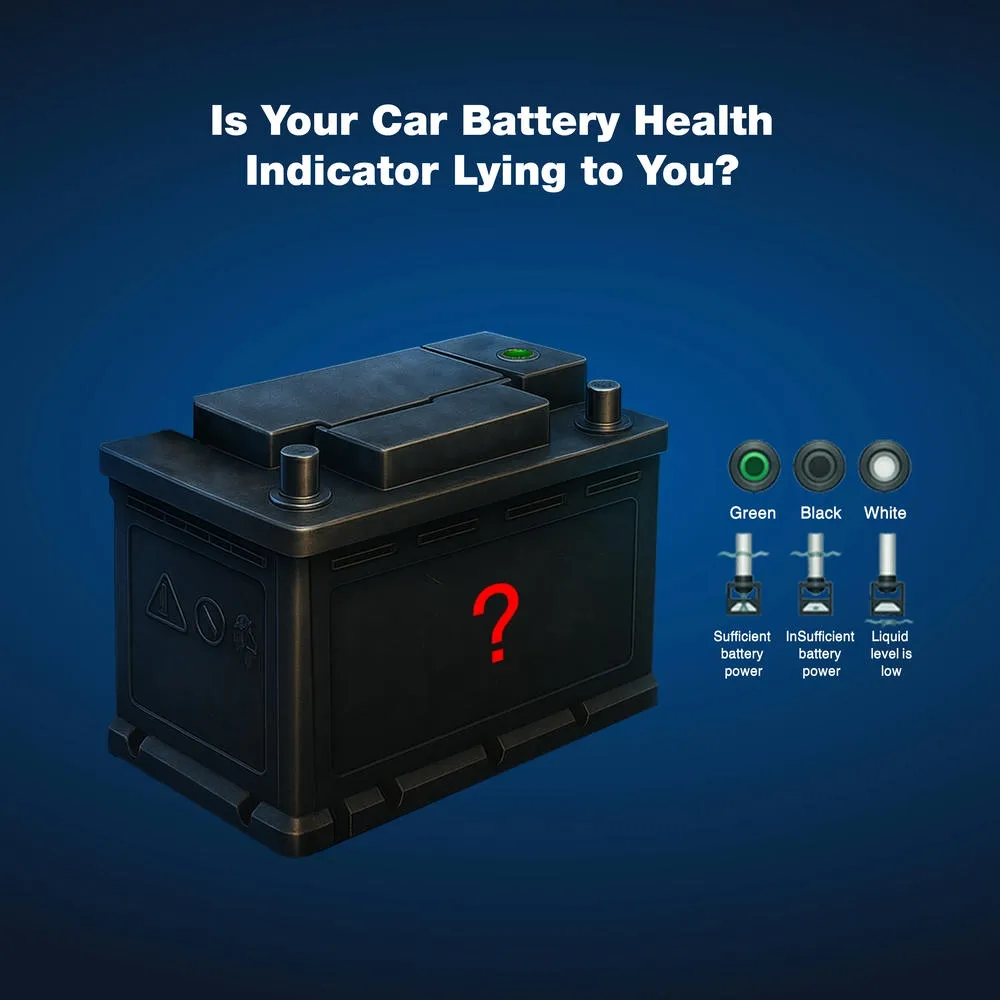
Many drivers take comfort in seeing a “green” or “OK” light on their car battery and assume everything is fine. Unfortunately, that little indicator may be telling only part of the truth.
Car battery health indicators — whether built into the battery case or shown on your dashboard are designed to provide a quick visual cue, not a complete diagnostic picture. Misinterpreting them can lead to unexpected failures, breakdowns, and premature battery replacements.
In this article, we’ll explain what these indicators actually measure, why they can be misleading, and what reliable testing methods experts recommend. Insights are based on guidance from automotive manufacturers and industry standards.
What Is a Car Battery Health Indicator?
A car battery health indicator is an electronic monitoring system that estimates the state of charge (SoC) and, in advanced versions, the state of health (SoH) of the vehicle’s battery. These may appear as a battery icon on the dashboard, a percentage reading in hybrid/electric vehicles, or part of the vehicle’s on-board diagnostics (OBD) system.[1][2]
In conventional petrol and diesel cars, the indicator is typically a small, simple voltage-based warning light that gives a colour-based signal of the battery’s condition. There are two main types:
- Built-in “magic eye” indicators – a small window on the battery’s top surface showing a green, black, or clear dot, typically monitor electrolyte level or charge state in a single cell.
- Dashboard battery symbols or system alerts – linked to the vehicle’s electrical management system, showing a battery warning light when voltage drops.
Neither type provides a complete view of your battery’s internal condition or overall capacity.
In stop-start, hybrid, and electric vehicles (EVs), more sophisticated battery management systems (BMS) use algorithms to assess capacity, internal resistance, and charge acceptance. [3][4] While helpful, these systems are not infallible diagnostic tools.
How Battery Indicators Actually Work
Traditional “magic eye” indicators were introduced to offer a simple status check without tools. Here’s how they function:
| Colour | Meaning | What It Actually Tells You |
| Green | Battery charged | Indicates sufficient charge in one cell only |
| Black/Dark | Needs charging | Battery partially discharged |
| Clear/Yellow | Low electrolyte | Possible fluid loss or battery ageing |
This indicator measures only one of six cells and cannot account for cell imbalance or sulphation elsewhere in the battery. A battery can appear “green” while still failing to deliver full current under load.
Other indicators rely on voltage monitoring, sometimes combined with current sensing and temperature compensation. The vehicle’s engine control unit (ECU) or dedicated BMS measures open-circuit voltage (OCV) when the engine is off and closed-circuit voltage (CCV) under load. [5][6]
In AGM-equipped stop-start vehicles, the BMS may track charge/discharge cycles, cranking performance, and resting voltage trends over time to estimate SoH.[7] For example, Varta’s Battery Management System uses proprietary algorithms to predict remaining capacity within ±10% accuracy under controlled conditions.[8]
However, these readings are estimates, not direct measurements of chemical health. The battery’s true condition—such as plate sulphation or electrolyte stratification—is invisible to most sensors. [9]
Common Types of Battery Monitoring Systems
| System Type | Vehicles Used In | Monitoring Method | Accuracy Level |
| Basic Voltage Warning Light | Most pre-2010 petrol/diesel cars | Voltage drop detection | Low – only detects critical failure |
| Intelligent Battery Sensor (IBS) | Stop-start, premium brands | Voltage, current, temperature | Moderate – ±15% SoH estimation |
| Full Battery Management System (BMS) | Hybrids, Electric Vehicles | Multi-parameter + cycle counting | High – ±5–10% under ideal conditions |
Sources: Bosch Automotive Handbook, Varta Technical Guide [10][11]
Dashboard battery symbols are also often misunderstood. The battery warning light doesn’t mean the battery is faulty — it typically signals a charging system problem, such as a worn alternator belt or voltage regulator issue.
Why Your Indicator Might Be Misleading
Despite technological advances, battery health indicators can under-report or over-report problems. In colder climates over 30% of winter breakdowns could be battery-related, yet many drivers report no prior warning from dashboard indicators.[12]
False Negatives
A battery showing “100%” or no warning may still fail under load. This occurs because:
- Voltage recovers quickly after shallow discharge, masking capacity loss.[13]
- Cold cranking amps (CCA) degrade before resting voltage drops significantly.[14]
False Positives
Conversely, a flickering warning light may appear due to:
- Loose terminals or poor earth connections.[15]
- Alternator overcharging triggering a fault code.[16]
Bosch diagnostics note that up to 25% of battery warning activations are caused by charging system faults, not the battery itself.[17]
Factors That Affect Indicator Accuracy
1. Built-in Indicator Only Measures One Cell
A built-in indicator gives feedback from a single cell, assuming all others are identical — an assumption that fails as the battery ages. If other cells are degraded or sulphated, you won’t know until the battery fails to start the car.
2. Surface Charge Can Mask Weakness
Immediately after charging or driving, surface charge elevates voltage readings temporarily. The indicator might show “green” even if true capacity is low.
3. Temperature and Driving Pattern Affects Readings
Battery voltage and internal resistance fluctuate with temperature. Cold weather can cause a false “bad” reading; heat can mask deterioration.[18] Frequent short trips prevent full recharge, skewing SoC readings.[19]
4. It Doesn’t Detect Internal Damage
Physical degradation such as plate shedding, sulphation, or shorted cells cannot be detected by the built-in indicator. These are the most common failure modes in ageing batteries.
5. Dashboard Lights Reflect Charging System, Not Battery Health
If the alternator fails, the battery warning light may appear — even when the battery itself is in perfect condition. Conversely, a weak battery may not trigger the dashboard light at all.
The Difference Between Voltage and True Battery Health
Many people equate battery voltage with battery health — a misconception. Voltage alone tells you how charged a battery is, not how healthy it is.
| Voltage (12V battery) | Approx. Charge Level | Usable Capacity Insight |
| 12.6–12.7 V | 100% | Fully charged |
| 12.4 V | ~75% | Acceptable, but recharge soon |
| 12.2 V | ~50% | Significantly discharged |
| 12.0 V or below | <25% | Likely to fail start |
A healthy battery should maintain voltage above 9.6 V during a load test (when cranking). Anything lower suggests internal weakness or sulphation — information that voltage or indicators alone cannot reveal.
According to Battery Council International (BCI) standards, proper diagnosis requires testing cold cranking amps (CCA) and state of health (SoH) using a conductance or load tester.
How to Accurately Test Your Car Battery
1. Professional Load Testing
Roadside services use conductance or carbon-pile load testers that measure voltage drop and internal resistance under controlled conditions. This provides a precise view of remaining capacity.
2. Use a Digital Conductance Tester
These testers apply a small AC signal to assess internal resistance, offering an accurate picture of State of Health (SoH) without fully discharging the battery. Recommended by Bosch and Exide for modern maintenance-free batteries.
3. Visual Inspection
Check for corrosion, cracks, bulging case, or electrolyte leakage (in serviceable batteries)[20]. Even a visually “clean” battery can fail internally, but these symptoms accelerate deterioration.
4. Check the Charging System
Test alternator output (typically 13.8–14.4 V). A weak charging system can lead to premature battery failure — and a misleading indicator reading.
5. Regular Preventive Testing
Most manufacturers recommend testing annually after the third year of use. Early detection saves money and prevents sudden breakdowns.
When to Trust (or Distrust) the Indicator
| Trust the Indicator | Distrust the Indicator |
| Consistent warning + slow cranking | Intermittent light with normal starting |
| Hybrid/EV shows <70% SoH after 5+ years | Light appears only when cold, disappears when warm |
| Recent conductance test confirms <70% capacity | No symptoms but light triggered after accessory fit |
Based on AA and Bosch diagnostic protocols [21][22]
Frequently Asked Questions (FAQ)
-
-
The indicator measures voltage in one cell. The battery may still have internal damage or insufficient cold cranking capacity.
-
-
Not immediately — recharge it first and have it tested professionally. A dark indicator often means low charge, not necessarily failure.
-
-
After three years of use, test annually. In hot or cold climates, consider testing every six months.
-
-
A conductance or load test, performed by a technician using approved equipment, is the only reliable measure of health.
-
-
Not necessarily. Cold increases internal resistance, triggering voltage drop alerts. Warm the battery and retest; if starting is normal, the battery may still have life.[23]
-
-
Some vehicles allow BMS reset via OBD tools, but this only clears codes—it doesn’t restore capacity. Professional diagnosis is advised.
-
-
Yes. EVs use advanced BMS with cell-level monitoring. Tesla, for example, guarantees 70% capacity retention after 8 years.
-
-
Possibly. A failing alternator can under- or over-charge the battery, triggering false alerts. Always test the charging system first.
Conclusion
Battery indicators serve a useful purpose — a quick visual cue — but they can give a false sense of security. Whether it’s a green dot on the battery or an illuminated dashboard symbol, these indicators tell only a fraction of the story.
True battery health depends on internal resistance, capacity, and how the battery performs under load — none of which can be assessed by a simple colour code or voltage reading.
The best practice is clear:
- Test your battery annually after its third year
- Use a professional conductance or load test
- Never rely solely on the built-in indicator
Following these steps ensures your car remains dependable and helps you avoid being stranded by a seemingly “healthy” battery that wasn’t.
References
- Bosch Automotive Handbook, 10th Edition (2021)
- Varta Automotive – Battery Management Systems Technical Guide (2023)
- Toyota Hybrid System Diagnostics Manual (2022)
- SAE International – J1939 Battery Monitoring Standards (2020)
- Delphi Technologies – Intelligent Battery Sensor Whitepaper (2021)
- CTEK Battery Academy – Voltage vs Capacity Correlation (2023)
- Exide Technologies – AGM Battery Performance Data (2022)
- Varta – BMS Algorithm Accuracy Report (internal, 2023)
- Battery Council International – Lead-Acid Degradation Mechanisms (2021)
- Bosch Automotive Handbook, Ch. 7: Electrical Systems
- Varta Technical Bulletin TB-2023-04
- RAC Winter Breakdown Statistics 2023/24
- Midtronics – Battery Diagnostics Best Practices (2022)
- Yuasa Battery Technical Manual (UK Edition, 2023)
- AA Technical Services – Common False Battery Warnings (2023)
- Denso Europe – Alternator Fault Diagnosis Guide (2022)
- Bosch ESI[tronic] Diagnostic Report, 2023
- Clarios – Temperature Effects on Battery Sensors (2021)
- RAC Drive – Short Journey Battery Impact Study (2022)
- Halfords Battery Inspection Checklist (2023)
- AA Battery Health Protocol (2024)
- Bosch Car Service Diagnostic Flowchart (2023)
- Yuasa Cold Weather Performance Data (2023)