
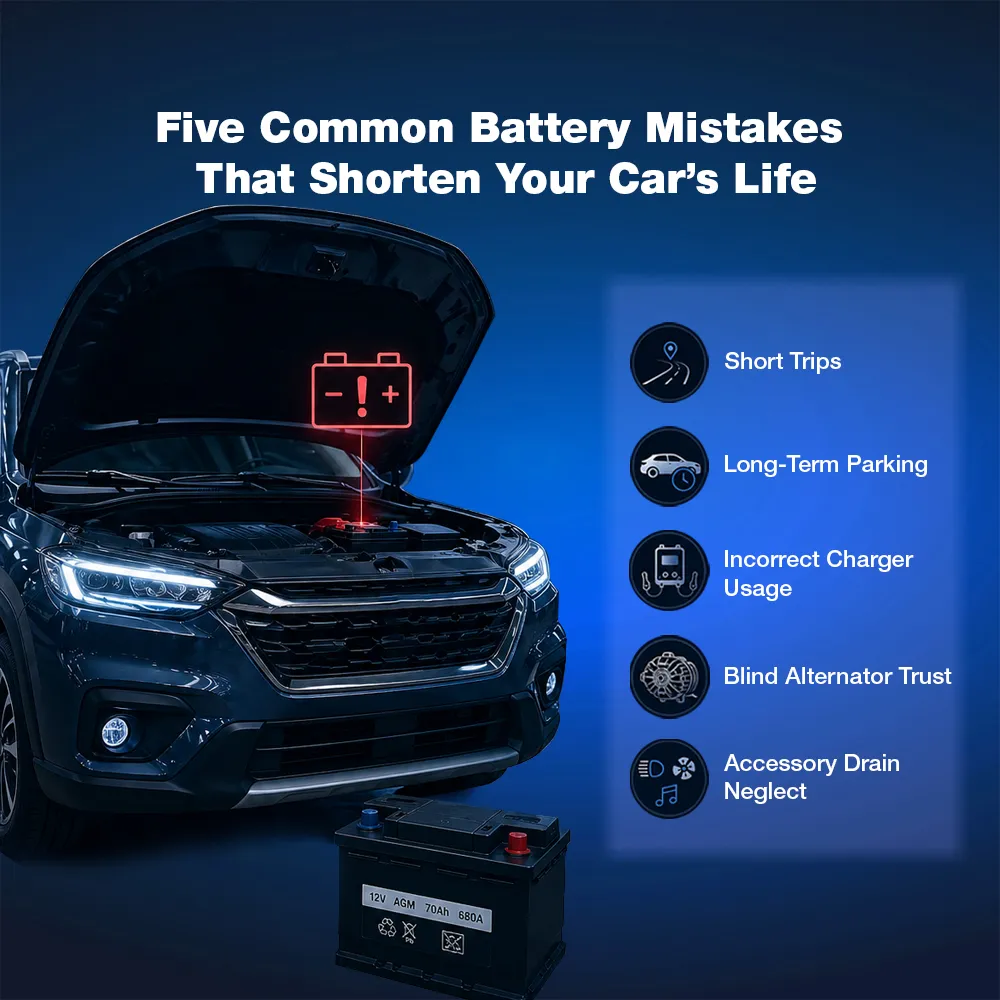
Five Common Battery Mistakes That Shorten Your Car’s Life is not a dramatic headline—it is a quiet reality observed daily in workshops, roadside recoveries, and warranty inspections.
Modern car batteries rarely fail without warning. Instead, they are gradually weakened by everyday habits that drivers do not recognize as harmful. At Suzuki, battery engineers frequently find that batteries reported as “defective” are, in fact, victims of repeated misuse rather than manufacturing faults.
Today’s vehicles—particularly SUVs and light commercial vehicles equipped with Start–Stop systems—place significantly more electrical stress on a 12-volt car battery than vehicles did a decade ago. Understanding what shortens battery life is no longer optional; it is now essential vehicle maintenance knowledge.
Below are the five most common battery mistakes, explained from the inside of the battery outward.
- 1. Are Short Trips Quietly Killing Your Car Battery?
- 2. Does Letting Your Car Sit Unused Damage the Battery?
- 3. Can the Wrong Charger Ruin an AGM or EFB Battery?
- 4. Is Your Alternator Actually Charging the Battery Properly?
- 5. Do Electrical Accessories Drain More Power Than You Expect?
- Key Takeaways
- Frequently Asked Questions
- Final Perspective
1. Are Short Trips Quietly Killing Your Car Battery?
Why it happens
Urban driving, school runs, delivery routes, and remote working have normalised journeys of five to ten minutes. The engine starts, the destination is reached, and the vehicle is switched off again—often several times per day.
What is happening inside the battery
Starting the engine draws a large burst of energy. Replacing that energy requires sustained alternator charging. On short trips, the alternator often lacks sufficient time to restore the charge removed during cranking—especially when headlights, infotainment systems, climate control, and safety electronics are active.
Chemically, the battery remains partially discharged. At higher temperatures and low state of charge during discharge lead sulphate crystals are formed and harden on the plates as we call it sulphation, crystals should be well-dispersed ideally. However, at low state of charge (SOC) and/or without applying a full charge regularly, large crystals grow which are inaccessible for charging. These crystals permanently reduce the battery’s usable capacity.
Long-term impact on battery life
Repeated partial charging accelerates degradation. Even AGM and EFB batteries, designed for Start–Stop systems, are not immune. The battery may appear healthy during voltage checks, yet lack usable energy.
Practical prevention (often overlooked)
- Include at least one longer drive (30–40 minutes) each week
- Disable Start–Stop during intensive urban use, if the vehicle allows (Very beneficial, the advantage is the formation of smaller lead sulphate crystals, inhibiting sulphation)
- For predominantly short-trip vehicles, periodic external charging is corrective maintenance—not excess caution
2. Does Letting Your Car Sit Unused Damage the Battery?
Why it happens
Second vehicles, seasonal cars, and fleet units often sit unused for days or weeks. Many owners assume that a stationary vehicle consumes no power.
What is happening inside the battery
Even when parked, modern vehicles draw current. Alarm systems, keyless entry modules, ECUs, trackers, and telematics create continuous parasitic drain. Over time, battery voltage drops below optimal levels.
As voltage falls, internal resistance increases, sulphation develops and chemical balance deteriorates—particularly in calcium-based (Ca–Ca) batteries with more sensitivity to partial SOC(PSOC).
Long-term impact on battery life
Repeated idle discharge dramatically shortens service life. A battery left partially discharged ages faster than one used regularly, regardless of age.
Practical prevention (often overlooked)
- Drive unused vehicles at least once every 7–10 days
- For long-term parking, disconnect the negative terminal or use a smart maintenance charger
- Avoid repeated jump-starting, which masks the issue without resolving it
3. Can the Wrong Charger Ruin an AGM or EFB Battery?
Why it happens
Battery chargers are often treated as interchangeable. A charger suitable for older vehicles is assumed to be appropriate for modern Start–Stop systems.
What is happening inside the battery
AGM and EFB batteries require tightly controlled charging profiles. Conventional chargers may overheat AGM batteries or fail to reach the absorption voltages they require.
Incorrect charging leads to uneven plate utilization, localized overheating, and premature grid corrosion. In AGM batteries, where electrolyte is immobilized, thermal damage is particularly severe.
Long-term impact on battery life
Improper charging reduces cycle life and can cause internal damage that routine tests fail to detect. Many apparent “sudden” AGM failures can be traced back to incorrect charging months earlier.
Practical prevention (often overlooked)
- Use chargers with dedicated AGM or EFB modes
- Avoid fast charging unless explicitly permitted by the manufacturer
- Do not assume alternator charging alone is sufficient after deep discharge
4. Is Your Alternator Actually Charging the Battery Properly?
Why it happens
A running engine does not guarantee effective battery charging. Modern alternator behavior is software-controlled and efficiency-driven.
What is happening inside the battery
Smart charging systems adjust voltage based on load, temperature, and fuel economy strategies. Charging may increase during braking and coasting, but reduce during acceleration.
If voltage remains low for extended periods, the battery never reaches full charge. Chronic undercharging is particularly harmful for AGM and EFB batteries.
Long-term impact on battery life
Undercharged batteries lose capacity and age prematurely. The charging system may be operating as designed, yet battery health steadily declines.
Practical prevention (often overlooked)
- Battery testing should include state of charge, not voltage alone
- After battery replacement, reset the vehicle’s battery management system if required
- Persistent undercharging should be diagnosed—not ignored
5. Do Electrical Accessories Drain More Power Than You Expect?
Why it happens
Dash cameras, auxiliary lighting, audio upgrades, inverters, and tracking devices are increasingly common, particularly in SUVs and light commercial vehicles.
What is happening inside the battery
Aftermarket accessories often bypass vehicle power management logic. Some continue drawing current after shutdown or exceed the charging system’s design assumptions.
This causes frequent micro-discharges and irregular charging patterns—both detrimental to battery chemistry.
Long-term impact on battery life
Battery ageing becomes uneven and unpredictable. Failures often occur without warning, particularly during cold starts.
Practical prevention (often overlooked)
- Ensure accessories are ignition-switched or time-limited
- Avoid direct battery connections unless professionally integrated
- Measure parasitic drain after electrical modifications
Key Takeaways
- Most car batteries fail due to usage patterns, not manufacturing defects
- Short journeys and long idle periods are among the most damaging habits
- AGM and EFB batteries require correct charging equipment and profiles
- Modern alternators do not always prioritize battery health
- Electrical accessories can quietly shorten battery lifespan
Frequently Asked Questions
Final Perspective
Battery technology has evolved rapidly, but driving habits often have not. Understanding these five common battery mistakes that shorten your car’s life allows drivers to work with modern vehicle systems rather than against them.
In practice, a few informed adjustments can add years to a battery’s service life—and prevent the kind of failure that always seems to occur at the worst possible moment.