
Lead-Acid Battery Recovery at Home: Safe Ways to Revive a Weak Car Battery
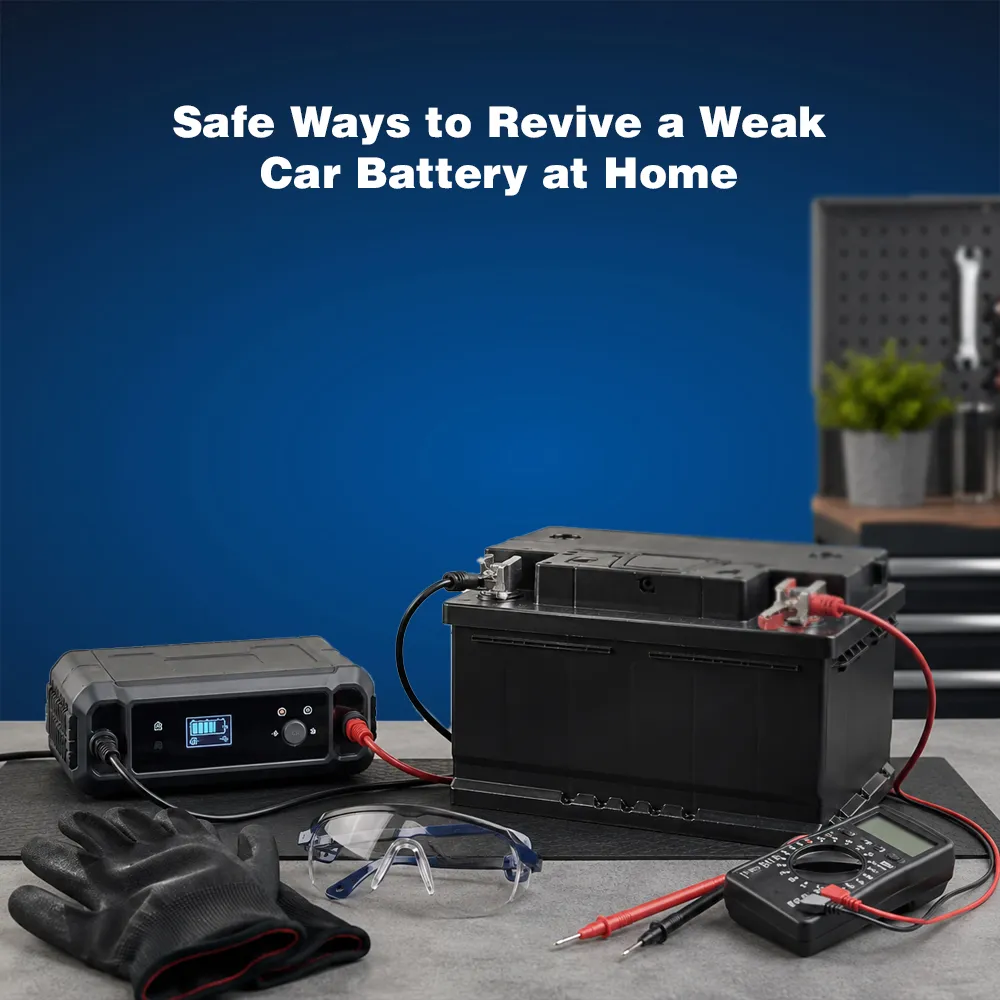
Learn how to safely recover a weak lead-acid car battery at home, when charging can help, and when replacing the battery is the safest solution.
What Does Lead-Acid Battery Recovery Mean?
A weak or flat lead-acid car battery does not always need replacing. In many cases, the battery is discharged or temporarily unable to deliver enough starting power because of:
- Leaving lights or accessories on
- Frequent short journeys
- Long periods of storage
- A faulty charging system
- Cold weather
If the battery has no internal damage, safe home recovery may restore enough charge for normal operation.
However, battery recovery is not the same as battery repair.
In this guide, battery recovery refers only to safe external procedures such as:
- Inspecting the battery
- Cleaning the terminals
- Charging with a smart charger
- Allowing the battery to rest
- Checking battery voltage
- Performing basic troubleshooting
It does not include opening a sealed or maintenance-free battery, replacing internal plates, adding acid or chemicals, drilling the case, flushing electrolyte or attempting internal repairs. These methods are unsafe, unreliable and should never be attempted at home.
Lead-acid batteries contain sulphuric acid and may release hydrogen gas during charging. They can also produce extremely high electrical current if short-circuited, making safe handling essential.
When You Should Stop Immediately
Do not attempt to charge or jump-start a battery if it is:
- Swollen
- Cracked
- Leaking acid
- Smoking
- Unusually hot
- Producing a strong rotten-egg smell
- Showing burn marks around the terminals
These symptoms may indicate internal failure or dangerous gas build-up.
The battery should be replaced and recycled through an authorised battery recycling facility.
Never charge or jump-start a frozen battery. Allow it to thaw naturally and inspect it for cracking or distortion before further testing.
Likewise, stop charging if:
- The charger repeatedly reports a fault
- The battery becomes unusually hot or heats rapidly during charging
- Voltage falls rapidly after an adequate rest period following charging
These signs require further investigation and may indicate internal battery failure rather than simple discharge.
Identify the Correct Battery Type
Before charging or replacing a battery, identify its technology and follow both the vehicle handbook and charger instructions.
Common automotive battery types include:
- Conventional flooded lead-acid
- Maintenance-free flooded lead-acid
- AGM (Absorbent Glass Mat, a VRLA technology)
- EFB (Enhanced Flooded Battery)
Charging voltage and programme must be compatible with the battery manufacturer’s specification; some chargers provide dedicated AGM or EFB modes.
Never open an AGM, VRLA, sealed or maintenance-free battery. On a serviceable flooded battery, check electrolyte only if the battery manufacturer explicitly permits it, and add only distilled or deionised water if specified; never add acid, chemicals or tap water.
Vehicles fitted with start-stop systems often require battery registration or a Battery Management System (BMS) reset after replacement so the charging system can correctly manage the new battery.
Carry Out These Safety Checks First
Inspect the battery for damage.
Check:
- Battery case
- Terminals
- Hold-down clamp
- Battery cables
- Surrounding wiring
Loose or corroded terminals can prevent sufficient current reaching the starter motor and may make a healthy battery appear faulty.
Before handling the battery:
- Switch off the ignition.
- Work in a well-ventilated area.
- Wear safety glasses and protective gloves.
- Keep sparks and naked flames away.
Before disconnecting the battery, check the vehicle handbook because some vehicles require specific procedures or may lose stored settings.
- Disconnect the negative terminal first.
- Reconnect the negative terminal last.
What Battery Voltage Really Tells You
Resting voltage is useful for estimating state of charge but cannot confirm battery health.
Allow the battery to rest for several hours after driving or charging before measuring.
| Resting Voltage | Possible Condition | Recommended Action |
| 12.6–12.8V | Fully charged | Investigate starter, cables or electrical system if the vehicle still will not start |
| Around 12.4V | Partially charged | Recharge and monitor |
| Around 12.2V | Low charge | Recharge soon |
| 12.0V or below | Very low state of charge | Recharge promptly if physically safe |
| Below 10.5V | Severe over-discharge or possible failed/shorted cell | Professional testing recommended before further charging |
| Voltage drops quickly | Possible surface-charge loss, self-discharge, external drain or internal fault | Retest after adequate rest; load or conductance test if needed |
| Unusual or rapid heating | Possible overcharge or internal fault | Stop charging immediately |
Note: These figures are approximate for a rested 12V lead-acid battery at moderate temperatures; battery type and temperature can shift the readings slightly. Surface charge immediately after charging can temporarily raise the reading. Voltage alone cannot confirm battery health; when the battery is physically safe to test, use an appropriate load or conductance test.
The Safest Way to Recover a Lead-Acid Battery
If the battery is physically sound, use an automatic smart charger designed for automotive batteries.
Always:
- Select the correct charging mode
- Match the charger to the battery type and manufacturer’s charging requirements (for example, Flooded, AGM or EFB)
- Avoid high-current boost charging unless specifically approved
Connect:
- For a battery installed in the vehicle, connect positive to positive
- Connect negative to the vehicle manufacturer’s recommended chassis earth or grounding point
- For a battery removed from the vehicle, connect positive to positive and negative to negative
Connect the clamps with the charger switched off or unplugged, then energise the charger. Disconnect charger power before removing the clamps, unless the charger instructions specify otherwise.
Allow the charger to complete its full charging programme.
Stop immediately if:
- The battery becomes unusually hot or heats rapidly
- Acid leaks
- A strong rotten-egg smell develops
- The charger repeatedly reports errors
A rotten-egg odour can indicate hydrogen sulphide release from severe overcharging or internal failure; hydrogen itself is odourless.
Understanding Battery Sulphation
Lead sulphate forms normally on the plates whenever a lead-acid battery discharges. Harmful sulphation develops when the battery remains partially or fully discharged for an extended period, allowing larger, more stable lead-sulphate crystals to form.
Mild sulphation may sometimes improve when using a manufacturer-approved smart charger with a desulphation or reconditioning mode, but recovery is not guaranteed.
However, no charger can:
- Repair a shorted cell
- Replace lost active material
- Reverse severe ageing
- Make an old battery perform like new
Avoid online “miracle” repair methods involving:
- Epsom salt
- Chemical additives
- Welding machines
- High-current shocks
These methods are unsafe and unsupported by battery manufacturers.
Why a Load Test Is Essential
Many batteries appear healthy because they show around 12.6V at rest.
However, starting a vehicle requires hundreds of amps.
A load test or a validated conductance test provides a more reliable assessment of available cold-cranking performance than resting voltage alone.
If it fails the test, replacement is normally the safest and most economical solution.
Why Does My Car Battery Keep Going Flat?
Repeated battery discharge usually points to another fault.
Common causes include:
- Weak alternator
- Loose battery cables
- Corroded terminals
- Electrical parasitic drain
- Interior or boot lights remaining on
- Dashcams
- Vehicle trackers
- Faulty relays
- Aftermarket accessories
- Control modules that fail to enter sleep mode
If the problem continues after charging, have the charging system professionally tested.
After a jump-start, do not rely on the alternator alone to recover a deeply discharged battery; use a suitable external charger to restore charge before testing battery condition.
When Should You Replace a Lead-Acid Battery?
Replace the battery if it:
- Is physically damaged
- Leaks acid
- Overheats
- Cannot hold charge
- Frequently requires jump-starting
- Fails a load test
- Is approaching the end of its service life
- Has become unreliable for everyday driving
For vehicles fitted with start-stop technology:
- Replace AGM with AGM.
- Replace EFB with EFB (or an approved upgrade where permitted).
Using the wrong battery technology may reduce battery life and affect vehicle performance.
How to Extend Battery Life
Simple maintenance can significantly extend battery life.
- Drive regularly.
- Avoid deep discharge.
- Keep terminals clean.
- Tighten battery connections.
- Switch off lights before leaving the vehicle.
- Use a maintenance charger during long storage.
- Secure the battery correctly.
- Test battery condition before long journeys and winter weather.
Suzuki Battery encourages safe charging, responsible recycling and replacing batteries promptly whenever safety or reliability becomes uncertain.
Frequently Asked Questions
-
-
Sometimes. If the battery has simply been discharged and has no internal damage, controlled charging may restore it.
-
-
Inspect it first, clean the terminals, use a suitable smart charger, allow the battery to rest afterwards, then confirm its condition with testing.
-
-
No. Sealed automotive batteries should never be opened, drilled or chemically treated.
-
-
Voltage alone does not measure battery capacity. The battery may still fail under load, or another fault may exist in the starter or electrical system.
-
-
Replacement is recommended if the battery is damaged, cannot hold charge, repeatedly fails, overheats, leaks or fails a professional load test.
Final Verdict
A weak lead-acid battery can often be safely recovered if the problem is simply a low state of charge. The correct approach is to inspect the battery, clean the terminals, charge it slowly with a smart charger, allow it to rest and verify its condition with appropriate testing.
Never attempt internal repairs or chemical restoration. If the battery is damaged, repeatedly loses charge or fails a load test, replacing it is the safest and most reliable solution.