
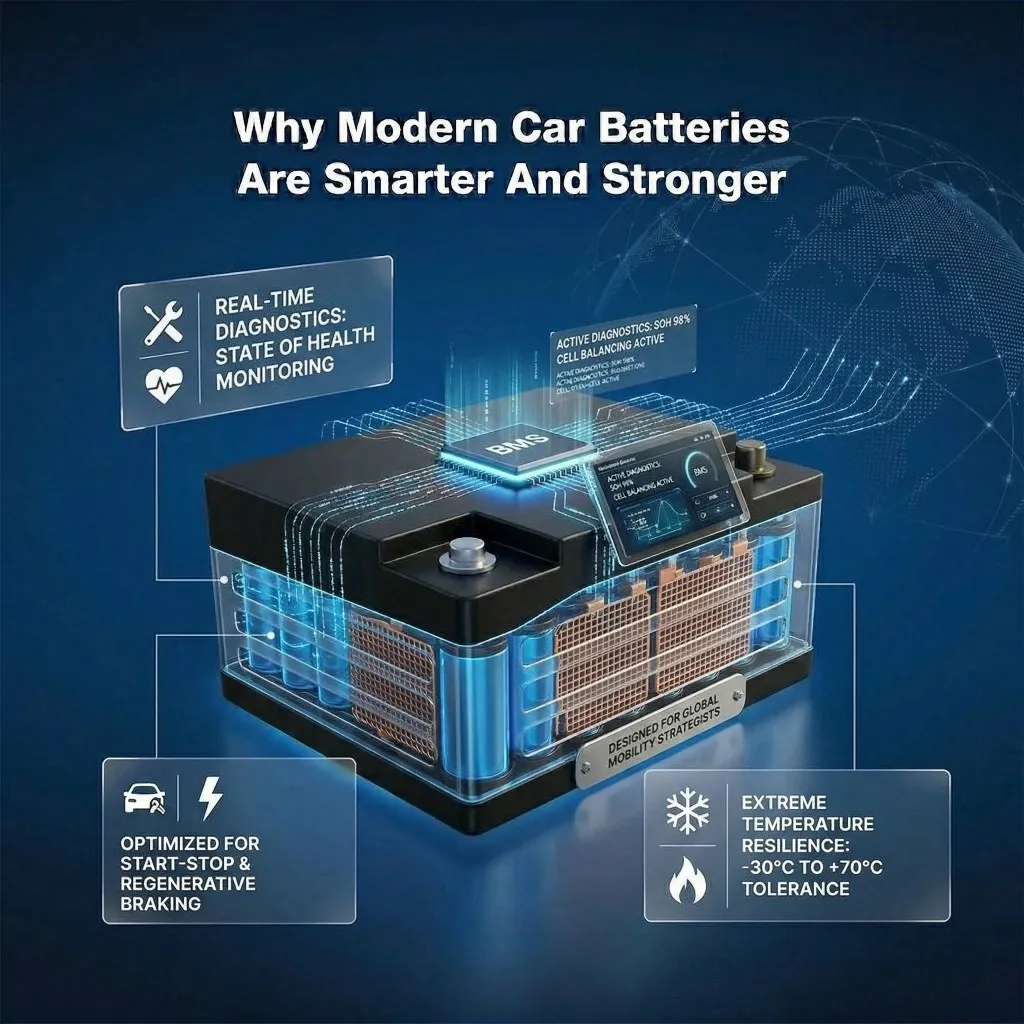
Open the bonnet of a 2025 hybrid or a premium combustion‑engine vehicle and the battery you see may look much like the one fitted twenty years ago: a rectangular plastic case with two exposed terminals. However, that familiar exterior now conceals a profound technological shift.
For decades, automotive batteries were treated as simple, brute‑force devices. Their job was straightforward: crank the engine, power accessories, and require little further attention. Modern batteries, by contrast, are sophisticated energy‑management units integrated into the vehicle’s electronic architecture. They no longer simply deliver voltage; they communicate, regulate, self‑diagnose, and adapt dynamically to driving conditions. In most 12‑V lead‑acid systems, this communication is enabled not by an internal Battery Management System (BMS), but through external Intelligent Battery Sensors (IBS) working in coordination with the vehicle’s ECU.
Whether you operate a commercial fleet, engineer EV platforms, or simply want reliable starts in humid climate, understanding why new-generation batteries differ from their predecessors is essential. Here is the engineering behind today’s “smart” powerpacks.
- The Shift: How New‑Generation Batteries Differ from Traditional Units
- The Brain Inside: How Automotive Battery Management Systems Work
- Start‑Stop Traffic and Deep Cycling: The Urban Stress Test
- Beating the Elements: Battery Chemistry and Extreme Heat
- Diagnostics and Maintenance: The End of the “Dead Battery Surprise”
- Are There Trade‑Offs to Modern Battery Technology?
- Should You Upgrade If Your Current Battery Still Works?
- Frequently Asked Questions (FAQs)
The Shift: How New‑Generation Batteries Differ from Traditional Units
Traditional flooded lead‑acid batteries rely on a simple electrochemical process: lead plates immersed in sulphuric acid. This design is robust yet limited, particularly under high electrical loads or extreme temperatures.
Modern battery chemistries—such as AGM (Absorbent Glass Mat), EFB (Enhanced Flooded Battery), and 12‑volt lithium‑ion starter batteries—represent a complete re‑engineering of the internal structure.
AGM (Absorbent Glass Mat):
In AGM (Absorbent Glass Mat) batteries, the electrolyte is absorbed into densely packed fiberglass mats, making the design spill‑proof and highly resistant to vibration. This robust construction makes AGM batteries ideal for start‑stop vehicles and applications with high electrical demand. As valve‑regulated lead‑acid (VRLA) systems, they maintain consistent pressure and performance without the need for regular maintenance.
EFB (Enhanced Flooded Battery):
EFB and AGM batteries feature a polyfleece scrim on the plates, which significantly improves charge acceptance and extends cycle life. They are specifically designed for start‑stop and mild hybrid systems, where frequent charging and discharging occur. These batteries are optimized for high Dynamic Charge Acceptance (DCA), a critical parameter that enables reliable performance in start‑stop operation.
Lithium‑Ion Starter Batteries:
Extremely light, capable of deep cycling, and resistant to degradation. Increasingly used in premium performance vehicles due to their fast‑charging and high‑output characteristics.
Core difference:
Older batteries act as passive storage units. Modern batteries actively manage charge acceptance, particularly during regenerative braking, and regulate output to support heavy loads even when the engine is off.
Engineering takeaway:
In contemporary vehicle design, the battery must be treated as a dynamic electrical node on the CAN bus—not merely a standalone reservoir.
The Brain Inside: How Automotive Battery Management Systems Work
Modern power packs are typically paired with a Battery Management System (BMS)—a dedicated microcontroller that ensures safe, efficient, and long‑term operation. In contrast, most traditional 12‑volt lead‑acid systems do not use an internal BMS and instead rely on external intelligent battery sensors (IBS) to monitor battery condition and performance.
A BMS provides several critical functions:
- Thermal Management
Batteries are extremely sensitive to heat. Recommended to replace with: In systems equipped with BMS (primarily lithium-ion), the system monitors cell temperature in real time and communicates with the charging system to reduce charging current when temperatures exceed safe thresholds. - Voltage and Cell Balancing
Particularly in lithium ion designs, the BMS ensures that all cells charge uniformly, preventing overcharge, accelerated wear, or thermal runaway. - State of Health (SoH) and State of Charge (SoC) Tracking
The BMS constantly evaluates capacity, internal resistance, and charge levels, providing early warnings to the dashboard long before a failure occurs.
By controlling the electrochemical environment so precisely, BMS‑equipped batteries can achieve double the operational reliability of traditional unmanaged units.
Start‑Stop Traffic and Deep Cycling: The Urban Stress Test
Urban driving places immense strain on automotive batteries. Vehicles equipped with start‑stop systems must:
- Power headlights, air conditioning, wipers, infotainment, and sensors while the engine is off, and
- Deliver a high‑current burst to restart the engine repeatedly.
A standard flooded battery would fail rapidly under this repeated deep‑cycling stress.
EFB and AGM batteries are built to endure this environment. Their reinforced plate structures and optimised active materials allow them to accept rapid recharge the moment the engine restarts. The alternator can immediately replenish the energy lost during idle.
Beating the Elements: Battery Chemistry and Extreme Heat
In tropical climates, heat is the primary cause of battery degradation. Elevated temperatures accelerate grid corrosion and electrolyte evaporation.
Modern battery designs are far more tolerant:
- AGM batteries are fully sealed, eliminating water loss.
- Reinforced polymer cases provide structural rigidity and heat resistance.
- Advanced lead alloys, often doped with silver or calcium, slow corrosion and extend service life.
- High‑density active materials limit sulphation when batteries are deeply discharged.
Whether running a dashcam overnight or operating heavy commercial equipment, modern powerpacks recover quickly and resist permanent damage far better than older flooded designs.
Diagnostics and Maintenance: The End of the “Dead Battery Surprise”
Today’s batteries feed continuous data into the vehicle’s ECU (Engine Control Unit). This allows predictive maintenance rather than guesswork.
Fleet operators benefit significantly—telematics systems can monitor SoC, SoH, and abnormal discharge patterns remotely. A fleet manager can replace a failing battery before a breakdown occurs.
For everyday drivers, the system translates diagnostics into simple dashboard alerts such as “Replace Battery Soon”.
Important owner tip:
If your vehicle uses a smart charging system, replacing the battery requires registration or coding via an OBD diagnostic tool. Without this step, the ECU may overcharge the new battery and shorten its service life.
Are There Trade‑Offs to Modern Battery Technology?
Smart batteries introduce certain limitations:
- Higher initial cost – AGM, EFB, and lithium‑ion units are more expensive than standard lead‑acid batteries.
- Specialised charging requirements – Older trickle chargers can damage modern chemistries; a compatible smart charger is essential.
- More complex replacement – Battery registration or coding is now routine for many vehicles.
Should You Upgrade If Your Current Battery Still Works?
Upgrading is recommended if:
- Your vehicle uses start‑stop technology,
- You have high electrical loads (dashcams, sound systems, accessories), or
- You operate in a high‑temperature region.
For commercial fleets, standardising on AGM batteries—even in older vehicles—significantly reduces downtime and can be financially advantageous.
However, there is generally no need to replace a functioning traditional battery pre‑emptively unless electrical demand exceeds its capability.