
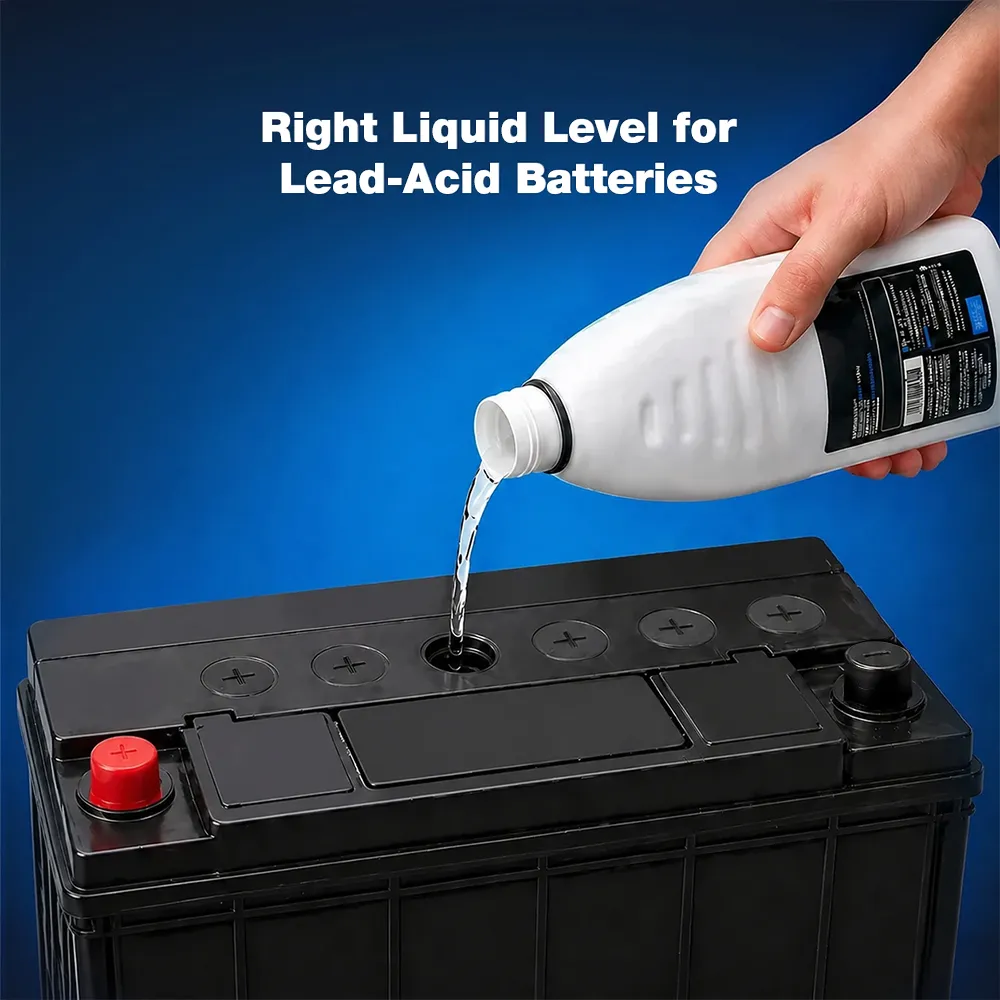
The right liquid level for lead-acid batteries is one of those fundamentals that sounds simple, yet causes more premature failures than most people realise. Too low, and the plates suffer. Too high, and you invite corrosion, leaks, and safety hazards.
The problem is not ignorance—it is assumption. Many batteries look similar on the outside, but internally they behave very differently.
This guide explains, in practical terms, how liquid levels work inside lead-acid batteries, which types actually need checking, and why “just adding a bit more water” is often the wrong move.
- Important Safety Notice
- What “Right Liquid Level” Actually Means Inside a Flooded Battery
- What Happens If The Liquid Level Is Too Low?
- What Happens If The Battery Is Overfilled?
- The Chemistry Behind Liquid Level (In Plain Language)
- How To Check The Liquid Level Correctly (Step-By-Step)
- How Often Should Liquid Levels Be Checked?
- Temperature And Usage Effects Most People Overlook
- Common Myths That Cause Expensive Mistakes
- Practical Checklist: Maintaining The Right Liquid Level
- Safety Notes Worth Taking Seriously
- Key Takeaways
- Frequently Asked Questions
- Final Thought
Important Safety Notice
The maintenance procedures described in this article apply ONLY to flooded (wet-cell), non-sealed lead-acid batteries equipped with removable inspection caps.
Sealed batteries — including SMF (Sealed Maintenance-Free), AGM (Absorbent Glass Mat), Gel, and all VRLA (Valve-Regulated Lead-Acid) types — must never be opened, topped up, drilled, or modified in any way.
Opening or adding liquid to a sealed battery:
- Permanently damages the internal oxygen recombination system
- Voids the manufacturer’s warranty
- May create serious safety hazards due to uncontrolled gas release or acid leakage
If your battery does not have clearly designed removable caps intended for electrolyte inspection by the manufacturer, do not attempt to open it under any circumstances.
When in doubt, consult the battery manufacturer or a qualified automotive technician before performing any maintenance.
Which lead-acid batteries actually have a liquid level?
Not all lead-acid batteries are created equal. Misidentifying the battery type is the fastest way to destroy a perfectly good battery. Before touching a filler cap, it is essential to know what you are dealing with.
Flooded (wet-cell) lead-acid batteries
These do require liquid level inspection and occasional topping up. The electrolyte is a mixture of sulphuric acid and water, and part of that water is gradually lost during normal charging.
Typical examples include:
- Conventional automotive starter batteries
- Flooded deep-cycle batteries
- Some industrial and backup power batteries
AGM (Absorbent Glass Mat) batteries
These must never be topped up. The electrolyte is absorbed into glass fibre mats. Opening or adding liquid disrupts the battery’s internal balance and permanently compromises its sealing.
Gel batteries
These also must never be topped up. The electrolyte is immobilised in a gel form. Adding liquid will permanently damage the structure.
Rule of thumb:
If the battery does not have removable caps designed for inspection, it is not meant to be opened.
What “Right Liquid Level” Actually Means Inside a Flooded Battery
The correct electrolyte level is not “as full as possible”. It is very specific.
In a healthy flooded battery:
- The liquid should fully cover the plates
- The level should sit just below the bottom of the filler tube
- There should be space for expansion when the battery warms during charging
Overfilling removes that expansion space. Underfilling exposes active material to air. Both shorten battery life, but in different ways.
What Happens If The Liquid Level Is Too Low?
Low electrolyte levels expose the upper portion of the plates. That exposure triggers a chain of damage.
Consequences of underfilling include:
- Accelerated sulphation on exposed plate surfaces
- Irreversible crystallization of lead sulphate (PbSO₄) when plates are exposed to air
- Permanent loss of active material
- Reduced capacity and weaker cold starting performance
- Localised heating during charging
In professional workshops, technicians often see batteries that appear “dead” simply because the plates were allowed to dry out at the top. Once that damage occurs, adding water later cannot reverse it.
What Happens If The Battery Is Overfilled?
Overfilling is surprisingly common, especially after a quick visual check.
Consequences of overfilling include:
- Electrolyte overflow during charging
- Acid damage to terminals, trays, and nearby components
- Increased self-discharge due to surface contamination
- Higher corrosion rates on internal connectors
Overfilled batteries also vent more aggressively. That vented acid mist does not disappear—it settles on metal, paint, and wiring. Electrolyte expands during charging and bubbling (gassing). If filled to the brim before charging, the expanded electrolyte can overflow once temperature rises.
Overfilling is not “extra care”—it is a different failure mode.
The Chemistry Behind Liquid Level (In Plain Language)
During charging, water in the electrolyte splits into hydrogen and oxygen gas. This is normal. What matters is control.
- Too little water means higher acid concentration and exposed plates
- Too much water dilutes the acid and increases spill risk
The battery is designed to operate within a narrow window. Staying inside that window keeps internal reactions stable and predictable.
How To Check The Liquid Level Correctly (Step-By-Step)
This applies only to flooded lead-acid batteries.
- Switch off the engine or charger and allow the battery to rest
- Wear eye protection and gloves
- Remove the vent or filler caps carefully
- Look straight down into each cell
- Do not use matches, lighters, or metal tools near open cells
- Confirm plates are fully submerged
- Top up only if necessary, using distilled or deionised water
- Fill to the recommended level—never to the brim
- Replace caps securely
Important:
If the plates are exposed, add water before charging. If the level is slightly low but plates are covered, topping up after charging often gives a more accurate final level. Never use tap water. Dissolved minerals accelerate plate degradation.
How Often Should Liquid Levels Be Checked?
There is no universal interval, but practical guidance helps.
- Private vehicles: every 3–6 months
- High-use or hot climates: every 1–2 months
- Industrial or standby systems: follow manufacturer schedules
Heat, vibration, and charging voltage all influence water loss. Batteries in hot regions simply need more attention. Always increase inspection frequency if visible corrosion or frequent water loss is observed.
Temperature And Usage Effects Most People Overlook
Temperature is one of the strongest predictors of water consumption.
- High ambient heat accelerates evaporation
- Frequent short trips increase charging stress
- Overcharging dries cells faster than age alone
A battery in a delivery vehicle can lose water twice as fast as the same model in a private car.
Common Myths That Cause Expensive Mistakes
“More water means longer battery life.”
No. Overfilling causes corrosion and leakage.
“AGM batteries just need less water.”
False. They need none.
“Tap water is fine in emergencies.”
It introduces minerals that permanently harm the plates.
“If it starts the car, the level must be fine.”
Starting ability is a poor indicator of long-term health.
Practical Checklist: Maintaining The Right Liquid Level
- Identify battery type before opening
- Use only distilled or deionised water
- Keep electrolyte just above the plates
- Leave expansion space
- Clean spills immediately
- Record inspection dates if managing multiple batteries
Safety Notes Worth Taking Seriously
- Electrolyte is corrosive
- Charging batteries produce flammable gas
- Never smoke or spark near open cells
- Rinse skin or eyes immediately if contact occurs
These are not theoretical risks. They are workshop realities.
Key Takeaways
- Only flooded lead-acid batteries require liquid level checks
- The correct liquid level for lead-acid batteries is never “full to the top”
- Overfilling is as damaging as underfilling
- AGM and gel batteries must never be opened
- Small maintenance habits prevent large failures
Frequently Asked Questions
Final Thought
Getting the liquid level right is not about perfection—it is about consistency. Batteries fail quietly, and electrolyte mistakes rarely announce themselves until damage is already done.