

If you’ve ever lifted a bonnet, clipped on a multimeter, and wondered whether the number on the screen is “good” or quietly spelling trouble, you’re not alone. How much voltage should a car battery have is a deceptively simple question because the answer depends entirely on when and how you measure it.
This guide doesn’t guess. It explains, in plain language, what the numbers really mean, why they change, and how to interpret them like a professional—without overcomplicating things.
- The Short Answer (For Quick Reference)
- What Voltage Should a Car Battery Have When The Engine Is Off?
- What Voltage Should a Car Battery Have When The Engine Is Running?
- Voltage Ranges Explained Simply
- Does Battery Type Change The “Correct” Voltage?
- How Temperature Affects Car Battery Voltage
- Common Myths About Car Battery Voltage
- Real-World Diagnostic Examples
- When Voltage Alone Is Misleading
- Key Takeaways
- Frequently Asked Questions
- Final Perspective
The Short Answer (For Quick Reference)
A healthy 12-volt car battery should read:
- Engine off (resting, 25°C reference temperature): about 12.6–12.75 volts
- Engine running: about 13.7–14.4 volts
These figures assume a healthy charging system and moderate temperatures. Anything meaningfully outside these ranges deserves attention—but context matters. A single number, taken at the wrong time, can mislead.
Note: Modern smart charging systems may operate outside this range under ECU control.
What Voltage Should a Car Battery Have When The Engine Is Off?
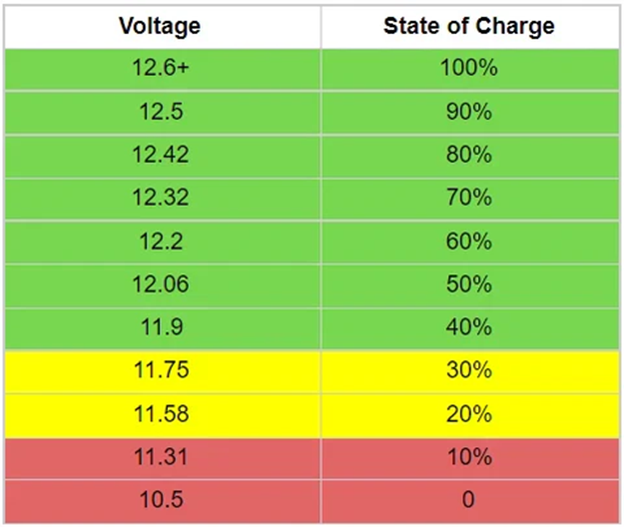
When the engine is off and the car has been off for at least 30 minutes (ideally a few hours), the battery is said to be at resting voltage. This is the most useful snapshot of its state of charge.
Healthy resting voltage ranges (flooded lead-acid, 25°C)
- 12.6–12.8 V → Fully charged, healthy
- 12.4–12.5 V → Partially charged, still serviceable
- 12.2–12.3 V → Low charge, starting reliability reduced
- Below 12.0 V → Critically low, likely sulphated or failing
In practice, a brand-new battery often sits closer to 12.7–12.8 V. As batteries age, their “full” voltage can drift slightly lower, even if they still start the engine.
What Voltage Should a Car Battery Have When The Engine Is Running?
Once the engine is running, the alternator supplies system voltage and recharges the battery, while the battery acts mainly as a stabilizer.
Normal running voltage
- 13.7–14.4 V → Normal charging range
- Below 13.5 V → Weak charging (possible alternator or belt issue)
- Above 14.7 V → Overcharging (regulator fault risk)
What many drivers don’t realise is that higher is not always better. Overcharging accelerates water loss and grid corrosion inside the battery—shortening its life quietly but decisively.
Voltage Ranges Explained Simply
Think of voltage as electrical pressure, not stored energy. It tells you how hard electrons want to move, not how much energy the battery can actually store.
- Healthy voltage means the battery is charged
- Low voltage means it’s discharged or struggling
- Normal voltage does not guarantee good health
A battery can show 12.6 V and still fail under load. This is why professionals never rely on voltage alone.
Does Battery Type Change The “Correct” Voltage?
Yes—slightly. Different lead-acid designs behave differently, even though they’re all called “12-volt” batteries. Mixing battery type and charging strategy is a common cause of premature failure.
Flooded lead-acid
- Typical full OCV: ~12.6–12.75V
- Absorption voltage: ~14.4V
- More sensitive to deep discharge
- Common in older vehicles
AGM (Absorbent Glass Mat)
- Typical full OCV: 12.7–12.85V
- Absorption charging voltage typically: 14.6–14.8V Tighter voltage tolerance
- Used in start-stop and premium vehicles
EFB (Enhanced Flooded Battery)
- Similar to AGM but slightly lower resting voltage
- Designed for frequent cycling
The mistake many people make is applying one rule to all batteries. Modern vehicles demand tighter voltage control, and the battery must match the charging system.
How Temperature Affects Car Battery Voltage
Voltage is temperature-sensitive—something often overlooked.
- Cold weather: Voltage drops, starting power reduces
- Hot weather: Voltage rises slightly, but ageing accelerates
Cold reduces chemical reaction speed. A battery that reads 12.4 V on a freezing morning may be perfectly healthy. Heat accelerates corrosion and evaporation. The same reading in summer heat is more concerning.
This is why experienced technicians always interpret voltage with conditions in mind.
Common Myths About Car Battery Voltage
“If it shows 12 volts, it’s fine.”
Not true. A failing battery can sit at 12.5 V and collapse under load.12.0V corresponds to roughly 25% SOC.
“Higher voltage means a better battery.”
Also false. Excess voltage often points to a charging fault, not strength.
“A jump start fixes low voltage.”
It masks the symptom. The underlying cause remains.
Real-World Diagnostic Examples
- Case 1: Battery reads 12.6 V, car won’t start
→ Likely internal damage or high internal resistance - Case 2: Battery reads 12.2 V after overnight parking
→ Possible parasitic drain or ageing battery - Case 3: Engine running at 15.1 V
→ Regulator fault, risk to electronics
These scenarios are more common than outright “dead” batteries—and voltage is the first clue, not the final verdict.
These examples show why voltage is useful—but never sufficient on its own.
When Voltage Alone Is Misleading
Voltage is a starting point, not a diagnosis.
A complete assessment considers:
- Cranking voltage drop
- Internal resistance
- Charging current OR Real-world load behaviour
This is why manufacturer-grade testing combines voltage with load or conductance measurements—especially for modern vehicles packed with electronics.
Practical and safe testing guidance
You don’t need a workshop to check voltage safely.
Basic steps:
- Let the car sit with the engine off for at least 30 minutes
- Set multimeter to DC volts
- Measure across battery terminals
- Repeat with engine running
Avoid:
- Shorting terminals
- Testing immediately after charging
- Interpreting results without context
Consistency matters more than a single reading.
Key Takeaways
- A healthy car battery rests around 12.6 V
- Running voltage should be 13.7–14.4 V
- Battery type and temperature matter
- Voltage alone doesn’t tell the whole story
- Context turns numbers into insight
Understanding voltage isn’t about memorising figures. It’s about knowing what those figures mean in the real world.
Frequently Asked Questions
Final Perspective
Voltage is the language your battery speaks. Learn to read it properly, and you stop guessing. Ignore its nuances, and even a “normal” number can lead you astray.
That distinction—between numbers and understanding—is where reliable decisions begin.