
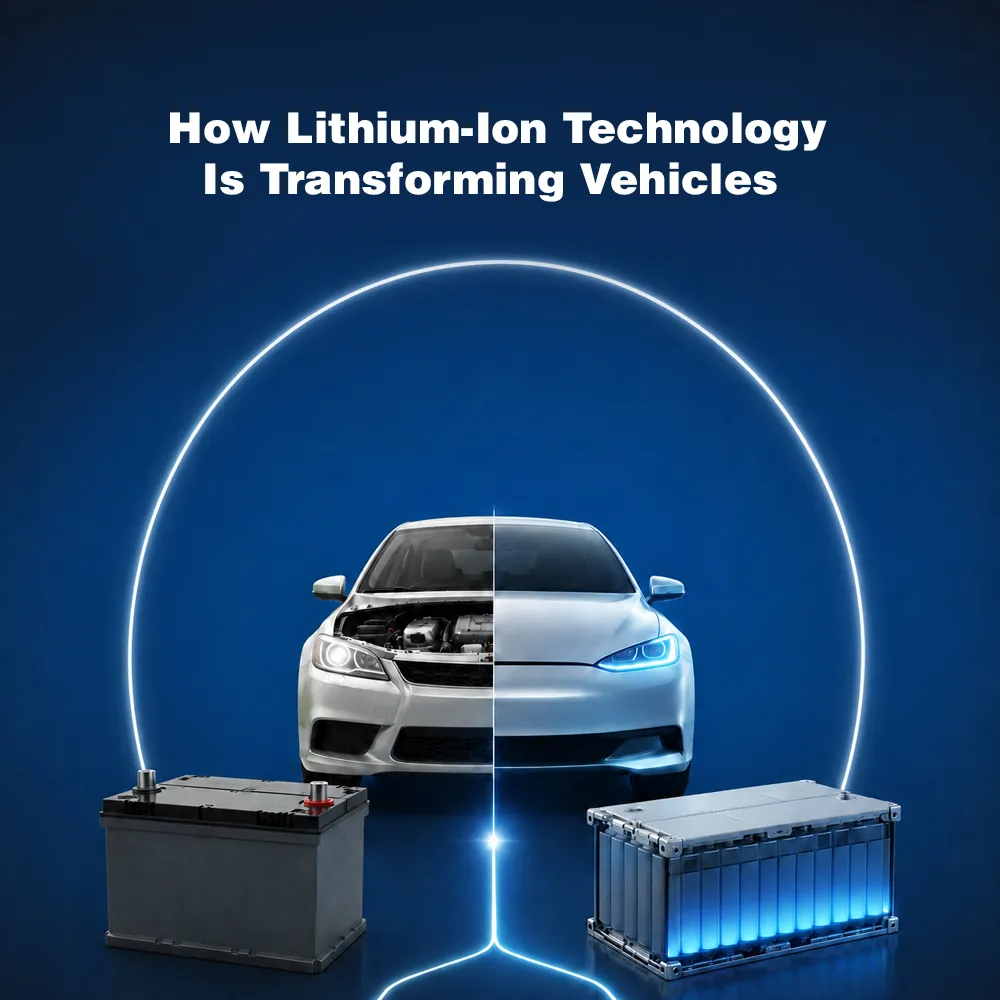
Lithium-ion battery technology is transforming the automotive industry. From high-voltage electric vehicle (EV) and hybrid battery packs to selected low-voltage 12V and 48V electrical systems, lithium battery technology can offer higher energy density, lower weight and improved efficiency than traditional lead-acid batteries in suitable applications.
For decades, the ordinary car battery was a heavy, familiar lead-acid box whose primary job was to start the engine and power basic electrical systems. Today, vehicles are far more sophisticated. Modern cars rely on advanced driver-assistance systems (ADAS), touchscreen infotainment, connected services, stop-start systems and increasingly complex electronics.
This shift is why lithium-ion technology matters. It is not simply powering electric vehicles; it is also influencing some low-voltage vehicle electrical systems. However, high-voltage EV battery packs and 12V replacement batteries are very different applications. Are lithium-ion batteries suitable for every vehicle, and will they eventually replace lead-acid batteries altogether? Understanding the strengths and limitations of each technology helps explain where automotive batteries are heading next.
- Key Takeaways
- What Are Lithium-Ion Car Batteries?
- Lithium-Ion vs Lead-Acid Batteries: Which Technology Is Better?
- Why Most Cars Still Use Lead-Acid Batteries
- Why Lithium-Ion Is Becoming Part of Modern Vehicle Power Systems
- Why EV Batteries Are Lithium-Ion
- Benefits of Lithium-Ion Car Batteries
- The Limitations Drivers Should Understand
- Are Lithium-Ion Batteries Better for the Environment?
- Can a Normal Car Use a Lithium-Ion Battery?
- Will Lithium-Ion Replace Lead-Acid Batteries?
- What This Means for Drivers
- The Future of Car Battery Technology
- Frequently Asked Questions
Key Takeaways
- Lithium-ion car batteries are generally lighter and more energy-dense than traditional lead-acid batteries, although lifespan depends strongly on chemistry, design, operating temperature and battery management.
- EVs rely on lithium-ion technology because it stores large amounts of energy in a relatively compact battery pack.
- Some modern vehicles use lithium-based 12V batteries, although a petrol or diesel vehicle should not be converted from lead-acid to lithium-ion unless the battery and charging system are specifically compatible.
- Lead-acid batteries remain popular because they are affordable, widely available and highly recyclable.
- The future of automotive batteries will likely include lithium-ion, LFP, sodium-ion, improved lead-acid and solid-state technologies.
What Are Lithium-Ion Car Batteries?
A lithium-ion automotive battery is a rechargeable battery that stores energy by moving lithium ions between electrodes during charging and discharging. In automotive applications, the term can refer either to high-voltage propulsion batteries used in electric and hybrid vehicles or to smaller low-voltage batteries designed for selected 12V or 48V systems.
High-voltage lithium-ion battery packs supply the energy required to propel electric vehicles. Hybrid models use them to support electric drive systems and recover energy through regenerative braking. Smaller lithium-based batteries may also replace or supplement conventional 12V batteries in certain vehicles, although this is a separate application with different safety, charging and compatibility requirements.
Unlike traditional lead-acid batteries, lithium-ion batteries rely on sophisticated Battery Management Systems (BMS). These electronic systems continuously monitor voltage, temperature and charging behaviour to maximise performance, improve safety and extend battery life. Without effective battery management, modern lithium-ion batteries would not be practical for automotive use.
Think of the battery as the vehicle’s energy store. A lead-acid battery is like a sturdy old cupboard: dependable, familiar and affordable. A lithium-ion battery is more like a modern storage system: lighter, more efficient and better suited to a vehicle filled with advanced technology.
Lithium-Ion vs Lead-Acid Batteries: Which Technology Is Better?
Lead-acid batteries have powered vehicles for more than a century. They are durable, relatively inexpensive and excellent at delivering the short burst of power needed to start an engine.
Lithium-ion batteries, however, can store far more energy for their size and weight. They charge more efficiently, support deeper discharge cycles and are better suited to modern electrified vehicles.
In practical terms:
- Lead-acid batteries are generally less expensive.
- Lithium-ion batteries are lighter and more energy-efficient.
- Lead-acid batteries are easier to source and replace worldwide.
- Lithium-ion batteries require sophisticated electronic management.
- Lead-acid remains common for 12V systems.
- Lithium-ion dominates EV battery packs.
For energy density and vehicle electrification, lithium-ion is the clear leader. For affordability, serviceability and established infrastructure, lead-acid continues to offer significant advantages.
Why Most Cars Still Use Lead-Acid Batteries
Given the advantages of lithium-ion technology, many drivers wonder why most petrol and diesel vehicles still use lead-acid batteries.
The answer is largely practical. Lead-acid batteries remain considerably less expensive to manufacture, replace and service. They also excel at delivering the high current needed to start an internal combustion engine, particularly in cold weather.
Existing vehicle charging systems, workshop practices and replacement networks have been built around lead-acid technology for decades. Mechanics understand them, replacement batteries are widely available and recycling systems are highly developed.
For many conventional vehicles, the benefits of lithium-ion do not yet justify the additional cost. As a result, lead-acid batteries are expected to remain common in standard 12V applications for many years.
Why Lithium-Ion Is Becoming Part of Modern Vehicle Power Systems
The traditional car battery had one primary role: starting the engine.
Today’s vehicles demand much more. Even compact cars may include ADAS features, parking sensors, cameras, connected services, stop-start systems and sophisticated infotainment systems.
This is where lithium-ion technology becomes attractive. Its superior energy-to-weight ratio helps manufacturers improve efficiency, optimise packaging and reduce vehicle weight.
For automotive manufacturers, the challenge is not simply adding more technology. It is balancing cost, reliability, durability, efficiency and serviceability across different markets and customer needs.
Why EV Batteries Are Lithium-Ion
Electric vehicles require batteries that can store large amounts of energy, recharge repeatedly and deliver power consistently.
Lithium-ion technology became the dominant EV battery solution because it offers an effective combination of:
- High energy density
- Long cycle life
- Good efficiency
- Scalable manufacturing
- Manageable weight
Different lithium chemistries serve different priorities. Some EVs use nickel-rich chemistries to maximise range, while others use lithium iron phosphate (LFP) batteries that prioritise durability, affordability and thermal stability.
Regardless of chemistry, lithium-based batteries make practical electric mobility possible.
Benefits of Lithium-Ion Car Batteries
1. Lower Weight
Weight affects fuel consumption, vehicle efficiency, handling and emissions. Lithium-ion batteries are significantly lighter than comparable lead-acid batteries, helping manufacturers improve overall vehicle performance.
2. Higher Energy Density
Lithium-ion batteries store considerably more energy within a given size or weight. This characteristic is essential for EVs and plug-in hybrids.
3. Faster Charging
Lithium-ion batteries generally accept charge more efficiently than lead-acid batteries, supporting regenerative braking and faster charging strategies.
4. Longer Lifespan
When properly designed, managed and used in suitable operating conditions, lithium-ion batteries can provide many years of reliable service. Battery management systems help maintain long-term health by controlling temperature, charging limits and cell balancing.
5. Lower Maintenance
Unlike older flooded lead-acid batteries, lithium-ion batteries require little routine maintenance and can be monitored electronically.
The Limitations Drivers Should Understand
Lithium-ion technology is powerful, but it is not without limitations.
Cost remains one of the biggest barriers. Lithium-ion batteries are generally more expensive than lead-acid alternatives, particularly in replacement applications.
Compatibility is another critical consideration. A standard lead-acid battery should not be replaced with a lithium-ion unit unless the vehicle charging system, battery management requirements, voltage range and cold-cranking needs are suitable for that specific lithium battery.
Temperature also affects performance. Extreme heat can accelerate battery ageing, while cold weather may temporarily reduce available power and may restrict charging unless the battery management system is designed to control low-temperature charging.
Safety is often misunderstood. Modern lithium-ion batteries are generally very safe when properly designed, manufactured and managed. Risks increase primarily when batteries are damaged, poorly installed or incorrectly charged.
Are Lithium-Ion Batteries Better for the Environment?
The environmental impact of lithium-ion batteries is complex.
On one hand, they enable electric vehicles, which can reduce tailpipe emissions and improve overall energy efficiency. On the other hand, battery production requires raw materials such as lithium, nickel, cobalt, manganese and graphite, all of which require mining and processing.
The industry is responding by:
- Improving battery recycling technologies
- Developing lower-impact battery chemistries
- Expanding second-life battery applications
- Reducing dependence on scarce materials
As recycling and manufacturing continue to improve, sustainability will become an increasingly important factor in battery development.
Can a Normal Car Use a Lithium-Ion Battery?
Sometimes, but not always.
Some lithium-ion 12V batteries are designed specifically for automotive applications, including motorsport, premium vehicles and specialist uses. However, replacing a standard lead-acid battery with lithium-ion is not a simple drop-in change unless the lithium battery is specifically designed and approved for that vehicle application.
Before making any change, drivers should verify:
- Vehicle manufacturer recommendations
- Charging system compatibility
- Battery size and terminal layout
- Cold-cranking performance requirements
- Battery management system protection, including low-temperature charging protection
- Warranty implications
For most drivers, the safest and technically correct option remains using the battery type recommended by the vehicle manufacturer.
Will Lithium-Ion Replace Lead-Acid Batteries?
Probably not entirely.
Lithium-ion batteries are expected to dominate electric vehicles and become increasingly common in advanced vehicle systems. However, lead-acid batteries remain affordable, reliable and supported by mature global recycling and service networks.
The future is more likely to involve multiple battery technologies coexisting. EVs will continue using large lithium-ion packs, while many conventional vehicles will continue relying on lead-acid or enhanced lead-acid batteries.
What This Means for Drivers
For drivers, lithium-ion technology may bring:
- Longer EV driving range
- Faster charging
- Improved energy efficiency
- Smarter battery health monitoring
- Potentially longer service intervals
Future vehicle buyers may increasingly consider battery chemistry alongside traditional factors such as engine size, performance and fuel economy.
The Future of Car Battery Technology
The next decade is unlikely to belong to a single battery technology.
Key developments are expected to include:
- Wider adoption of LFP batteries
- Growth of sodium-ion technology in selected applications
- Progress towards commercial solid-state batteries
- Better recycling systems
- More second-life battery uses
- Smarter software-based battery management
- Expanded 48V electrification systems
The future of vehicle battery systems is not simply electric. It is intelligent, connected and increasingly shaped by advances in energy storage technology.