
- Quick answer: How Much Does a Car Battery Weigh?
- Typical Car Battery Weight By Vehicle Type
- Why Are Car Batteries So Heavy?
- Battery Weight By Battery Type
- Is a Heavier Car Battery Better?
- Does Battery Weight Affect Performance?
- How to Find Your Exact Car Battery Weight
- Can You Lift a Car Battery Yourself?
- Standard Car Battery vs EV Battery Weight
- Key Takeaways
- FAQs
Most standard 12V car batteries weigh between 10 and 25 kg, although the exact weight depends on the battery size, chemistry, capacity and the type of vehicle. Small city cars typically use lighter batteries, while diesel vehicles, SUVs, taxis and commercial vans often require larger, heavier batteries with greater starting power.
In this article, “car battery” mainly refers to the 12V starter or auxiliary battery, unless hybrid or EV traction battery packs are specifically mentioned.
Quick answer: How Much Does a Car Battery Weigh?
A typical 12V passenger car battery weighs between 11 and 22 kg.
- Small city cars: 10–15 kg
- Hatchbacks and saloons: 11–20 kg
- SUVs and diesel vehicles: 18–30 kg
- Commercial vehicles: 25–45 kg or more
Although a car battery appears compact, it is surprisingly heavy because it contains dense materials such as lead plates and electrolyte that are required to produce high starting current.
Typical Car Battery Weight By Vehicle Type
| Vehicle Type | Typical Battery Weight | Common Reason |
| Motorcycle | 2–8 kg | Smaller engine, lower starting demand |
| Small City Car | 10–15 kg | Compact battery size and moderate capacity |
| Compact Car / Hatchback | 11–17 kg | Standard 12V lead-acid or EFB battery |
| Mid-Size Sedan | 14–22 kg | Higher electrical load and capacity |
| SUV / Crossover | 18–28 kg | Larger engine and more onboard electronics |
| Taxi / Ride-Hailing Vehicle | 18–30 kg | Frequent starts and heavy daily use |
| Pickup / Light Truck | 20–32 kg | Higher cold cranking amps and reserve capacity |
| Commercial Vehicle | 25–45 kg+ | Heavy-duty starting and auxiliary power needs |
These figures are practical estimates. Always check the battery label, owner’s manual or supplier specification for the exact weight.
Why Are Car Batteries So Heavy?
Most conventional car batteries are lead-acid batteries, and lead is one of the densest metals commonly used in automotive applications.
In a conventional lead-acid battery, the main weight comes from:
- Lead-based plates and active materials, which take part in electrochemical reactions with the sulphuric acid electrolyte to store and release electrical energy
- Electrolyte fluid, a mixture of sulphuric acid and water
- Plastic casing, separators, terminals and internal supports
- Extra capacity, measured in amp-hours and reserve capacity
In simple terms, more starting power, more battery capacity and stronger internal construction usually mean more weight.
Battery Weight By Battery Type
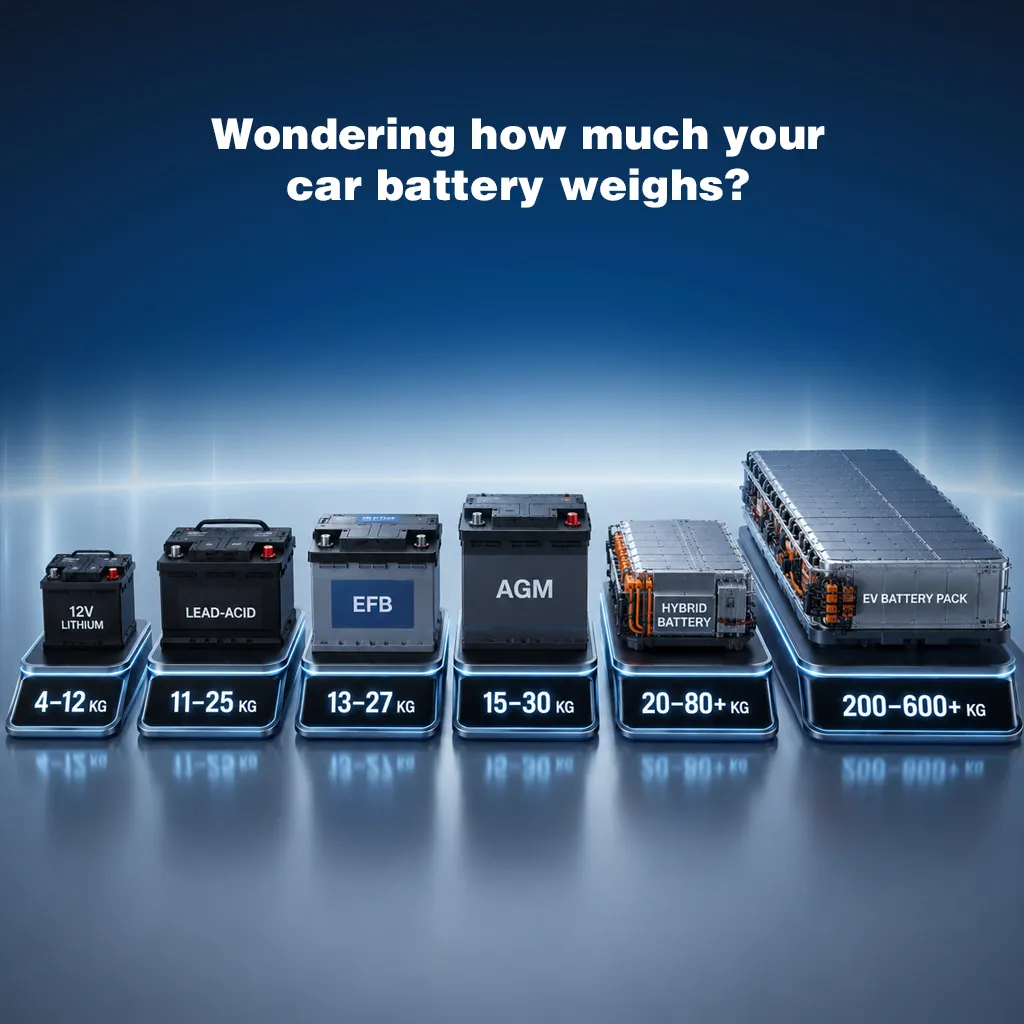
| Battery Type | Typical Weight Range | Common Applications |
| Flooded Lead-Acid Battery | 11–25 kg | Standard petrol and diesel cars |
| EFB Battery | 13–27 kg | Start-stop vehicles and daily urban driving |
| AGM Battery | 15–30 kg | Start-stop cars, premium vehicles, higher electrical loads |
| Lithium 12V Car Battery | 4–12 kg | Lightweight performance or specialist use |
| Hybrid Battery Pack | 20–80 kg+ | Hybrid vehicle propulsion assistance |
| Full EV Battery Pack | 200–600 kg+ | Main traction battery for electric driving |
AGM batteries generally weigh more than conventional flooded batteries because they contain additional lead and glass mat separators, allowing them to deliver higher performance, improved durability and better resistance to repeated charging cycles.
A lithium car battery can be much lighter than a lead-acid battery, but it is not always a direct replacement. Vehicle compatibility, charging system requirements, climate conditions and vehicle electronics should be considered before upgrading. In vehicles with start-stop systems, smart charging systems or battery management systems, the replacement battery must match the required technology and may require registration or coding after installation.
Is a Heavier Car Battery Better?
Not necessarily.
Weight can indicate stronger construction or higher capacity, but the right battery is the one that matches your vehicle’s required specification. A battery should fit the correct physical size, terminal layout, voltage, cold cranking amps and capacity.
For example, a Suzuki compact car and a large diesel SUV may both use 12V batteries, but they will not necessarily need the same battery size or weight. The better choice is not the heaviest one; it is the battery designed for the vehicle’s electrical demand and installation space.
Does Battery Weight Affect Performance?
Battery weight can affect performance indirectly. In normal daily driving, a few extra kilograms will not be noticeable for most drivers. However, battery weight matters more in:
- Small vehicles where every kilogram affects efficiency
- Motorsport or performance cars
- Commercial fleets where payload matters
- Motorcycles and compact vehicles
- Electric Vehicles, where battery mass strongly affects driving range and handling
In most passenger cars, battery performance is determined by specification: cold cranking amps, amp-hour rating, reserve capacity, chemistry and warranty.
How to Find Your Exact Car Battery Weight
The easiest way is to check the battery label. Many batteries list the model code, voltage, capacity, cold cranking amps and sometimes the weight.
You can also find the exact weight by checking:
- The owner’s manual
Look for the recommended battery size and specification. - The battery manufacturer’s website
Search the exact model number printed on the battery. - A parts catalogue or battery finder tool
Enter your vehicle make, model, year and engine type. - A workshop or battery retailer
They can match the correct battery group size and weight. - The existing battery itself
If safe to do so, note the model code before replacement.
Do not guess weight based solely on appearance. Two batteries can look similar but differ in capacity, internal design and weight.
Can You Lift a Car Battery Yourself?
Many drivers can lift a standard car battery, but it should be done carefully. Even a 15 kg battery can be awkward because it is dense, rectangular and often positioned in a tight engine bay.
Follow basic battery handling safety:
- Wear gloves and eye protection where possible.
- Keep the battery upright.
- Avoid touching both terminals with tools.
- Do not lift by damaged handles.
- Bend your knees, not your back.
- Keep metal jewellery away from the terminals.
- Never dispose of an old battery in household waste.
Car batteries contain hazardous materials and should be recycled through authorised collection centres, workshops or battery retailers.
Standard Car Battery vs EV Battery Weight
A conventional 12V car battery is designed primarily to start the engine and power low-voltage electrical systems. It typically weighs between 11 and 22 kg.
By contrast, the traction battery in a fully electric vehicle powers the vehicle itself and commonly weighs between 200 and 600 kg, depending on battery capacity and vehicle size.
Most electric vehicles also use a separate low-voltage auxiliary battery, commonly 12V, to operate lighting, safety systems, control modules and accessories.
Key Takeaways
- A typical 12V car battery weighs around 11–22 kg.
- Small cars typically use batteries weighing 10–15 kg.
- SUVs, taxis, trucks and commercial vehicles usually need heavier batteries.
- AGM and EFB batteries may weigh more than basic flooded batteries.
- EV battery packs are far heavier than standard automotive batteries.
- A heavier battery is not automatically better; correct specification matters most.
- When replacing a battery, always choose the correct specification rather than simply selecting the heaviest battery.