
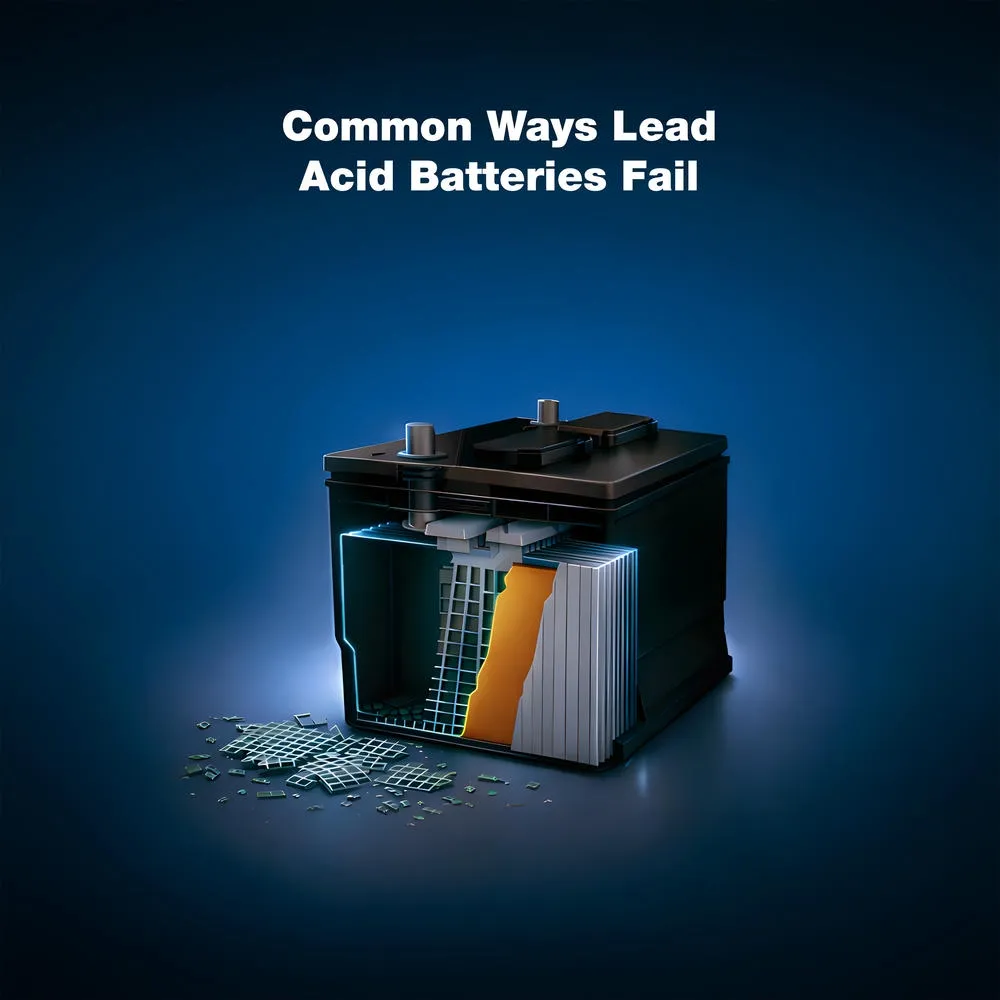
Lead-acid batteries—flooded, AGM (Absorbent Glass Mat), and gel—remain widely used across automotive, industrial, renewable energy, and standby power applications. Their chemistry is mature, costs are relatively low, and performance is predictable when the batteries are correctly charged and maintained. Nevertheless, lead-acid batteries tend to fail in well‑understood and largely preventable ways when exposed to improper charging, inadequate maintenance, or harsh operating conditions.
This article examines the most common failure modes of lead-acid batteries, explaining why they occur, how to recognise early warning signs, and what practical steps can be taken to minimise degradation and extend service life. It is intended for engineers, technicians, system designers, and informed end-users responsible for battery selection, operation, or maintenance.
- How Lead-Acid Batteries Work
- Sulphation
- Grid Corrosion
- Shedding of Active Material
- Electrolyte Loss and Dry‑Out
- Stratification
- Thermal Runaway
- Plate Shorting and Internal Damage
- Environmental and Operational Factors That Accelerate Failure
- Maintenance and Monitoring Strategies
- Frequently Asked Questions (FAQ)
- Conclusion
- References
How Lead-Acid Batteries Work
A typical lead-acid cell consists of:
- Positive plates coated with lead dioxide (PbO₂)
- Negative plates made of spongy lead (Pb)
- A sulphuric acid electrolyte
- Separators that prevent direct contact between plates
During discharge, lead sulphate forms on both plates while the electrolyte becomes more dilute. Charging reverses this process by converting lead sulphate back into lead dioxide, spongy lead, and sulphuric acid—provided the battery is charged fully and correctly.
Any sustained deviation from the ideal charge–discharge cycle, electrolyte balance, or operating temperature can trigger irreversible chemical or mechanical changes. These changes underpin the majority of lead-acid battery failure modes.
Sulphation
Description
Sulphation occurs when lead sulphate (PbSO₄) crystals form on the plates and harden, reducing the active surface area available for electrochemical reactions. It most commonly develops when a battery remains undercharged or is stored at a low state of charge for extended periods. In deep‑cycle applications, leaving a battery below approximately 50 % state of charge for weeks or months is a leading cause of premature failure.
Causes
- Chronic undercharging or partial‑state‑of‑charge (PSOC) operation
- Long‑term storage without maintenance charging
- Low electrolyte levels in flooded batteries
- Cold environments, which reduce charge acceptance
Effects
- Reduced usable capacity
- Increased internal resistance
- Longer charging times
- Poor cold‑cranking performance in starting batteries
Prevention
- Use a proper multi‑stage charging profile (bulk, absorption, and float / IUoU)
- Avoid storing batteries in a low state of charge
- Apply periodic equalisation to flooded batteries, where permitted by the manufacturer
Grid Corrosion
Description
The positive grid is typically manufactured from lead‑antimony or lead‑calcium alloys. Over time, especially in hot climates or under chronic overcharging, the grid corrodes and expands. This can ultimately lead to grid fracture or loss of electrical continuity. In float‑service applications, grid corrosion is often the dominant life‑limiting mechanism.
Causes
- Excessively high float voltages
- Prolonged exposure to temperatures above 30 °C
- Long‑term overcharging
- Electrolyte impurities
Effects
- Reduced electrical conductivity
- Plate expansion, distortion, and cracking
- Loss of adhesion between the grid and active material
Prevention
- Maintain float voltage strictly within manufacturer limits
- Control ambient temperature and ensure adequate ventilation
- Select batteries rated for high‑temperature environments when required
Shedding of Active Material
Description
During repeated charge–discharge cycles, the active material on both positive and negative plates gradually softens and sheds from the grid structure. The shed material accumulates as sediment at the bottom of the cell.
Causes
- Deep or frequent cycling beyond the battery’s design intent
- High discharge currents
- Mechanical vibration or shock (common in automotive and marine environments)
- Natural ageing of the paste structure
Effects
- Progressive loss of capacity
- Shortened service life
- Eventual internal short circuit if sediment bridges the plates
Prevention
- Avoid deep discharges unless the battery is specifically designed for cycling
- Secure batteries firmly to minimise vibration
- Use true deep‑cycle batteries for cyclic applications
Electrolyte Loss and Dry‑Out
Description
Flooded batteries lose water through electrolysis and evaporation over time. AGM and gel batteries can also suffer electrolyte dry‑out if they are overcharged or operated at elevated temperatures. When electrolyte levels fall, portions of the plates may be exposed to air, causing irreversible oxidation and accelerated degradation.
Causes
- Overcharging
- High ambient temperatures
- Poor ventilation
- Failure to top up distilled water in flooded batteries
Effects
- Increased internal resistance
- Reduced heat dissipation
- Accelerated sulphation
- Heightened thermal stress
Prevention
- Periodically, top up flooded batteries with distilled water
- Use chargers with temperature compensation
- Ensure proper ventilation in battery enclosures and rooms
Stratification
Description
Stratification occurs when denser, more acidic electrolyte settles at the bottom of the cell, leaving weaker electrolyte near the top. This leads to uneven plate utilisation and accelerated corrosion at the lower sections of the plates.
Causes
- Light or shallow cycling
- Incomplete charging that prevents electrolyte mixing
- Limited gassing in flooded batteries
- Cold operating environments
Effects
- Reduced effective capacity
- Uneven current distribution across plates
- Localised corrosion at the bottom of the plates
Prevention
- Periodically equalise flooded batteries (for example, around 15.5 V for a 12 V battery, adjusted for temperature and manufacturer guidance)
- Ensure chargers provide sufficient absorption time
- Avoid prolonged shallow cycling in deep‑cycle systems
AGM and gel batteries are significantly less susceptible to stratification due to immobilised electrolyte, although severe or chronic undercharging can still cause internal imbalances.
Thermal Runaway
Description
Thermal runaway is most commonly associated with VRLA (AGM and gel) batteries operating on float charge. Heat generated by internal recombination reactions raises battery temperature, which reduces internal resistance, increases charging current, and generates even more heat—creating a self‑reinforcing cycle.
Causes
- High ambient temperatures combined with overcharging
- Chargers lacking temperature compensation
- Restricted ventilation
- Internal cell defects or ageing
Effects
- Battery swelling or deformation
- Excessive surface temperature
- Rapid electrolyte loss
- Venting, rupture, or catastrophic failure in extreme cases
Prevention
- Use temperature‑compensated charging and thermal monitoring
- Maintain adequate airflow around battery banks
- Replace ageing or damaged batteries before failure escalates
Plate Shorting and Internal Damage
Description
Internal short circuits occur when separators fail, plates warp, or shed material bridges the gap between plates. This is one of the most common causes of sudden and complete battery failure.
Causes
- Manufacturing defects
- Physical shock or sustained vibration
- Electrolyte contamination
- Severe overcharging or thermal expansion
Effects
- Rapid self‑discharge
- Abnormal or uneven cell voltages
- Immediate loss of battery function
Prevention
- Secure batteries using appropriate mounting hardware
- Source batteries from reputable manufacturers
- Inspect regularly for swelling, deformation, or abnormal heating
Environmental and Operational Factors That Accelerate Failure
Lead‑acid batteries experience significantly reduced service life when exposed to:
- High temperatures: as a widely cited industry rule of thumb, every 10 °C rise above 25 °C can halve service life.
- Incorrect charging profiles: inappropriate voltage settings remain the single most common cause of premature failure.
- Excessive cycling: many batteries are not designed for deep or frequent cycling.
- Long‑term storage without maintenance charging: a primary driver of severe sulphation.
- Vibration and shock: which accelerate shedding and mechanical damage.
- Contamination: dust or metallic particles can cause internal short circuits.
Maintenance and Monitoring Strategies
To maximise service life and reliability:
- Set bulk, absorption, and float voltages strictly according to the manufacturer’s datasheet.
- Use chargers with temperature compensation.
- Regularly measure open‑circuit voltage and, for flooded batteries, specific gravity.
- Inspect terminals and connections for corrosion or looseness.
- Keep battery surfaces clean and dry to prevent stray currents.
- Use battery monitoring or management systems in critical or industrial installations.
- Perform equalisation only when recommended and appropriate for the battery type.
Frequently Asked Questions (FAQ)
Conclusion
Lead‑acid batteries tend to fail in predictable and well‑documented ways. Sulphation, grid corrosion, active‑material shedding, stratification, and thermal runaway account for the majority of premature failures.
With correct charging practices, routine inspection, and appropriate environmental control, the service life and reliability of lead‑acid batteries can be significantly extended.
References
These sources provide authoritative technical background and industry-standard guidance:
- Battery University — Failure Modes of Lead-Acid Batteries
https://batteryuniversity.com/article/bu-804-how-to-prolong-lead-acid-batteries - Trojan Battery Company – Technical Manual (2023) https://www.trojanbattery.com/tech-support/battery-maintenance/