
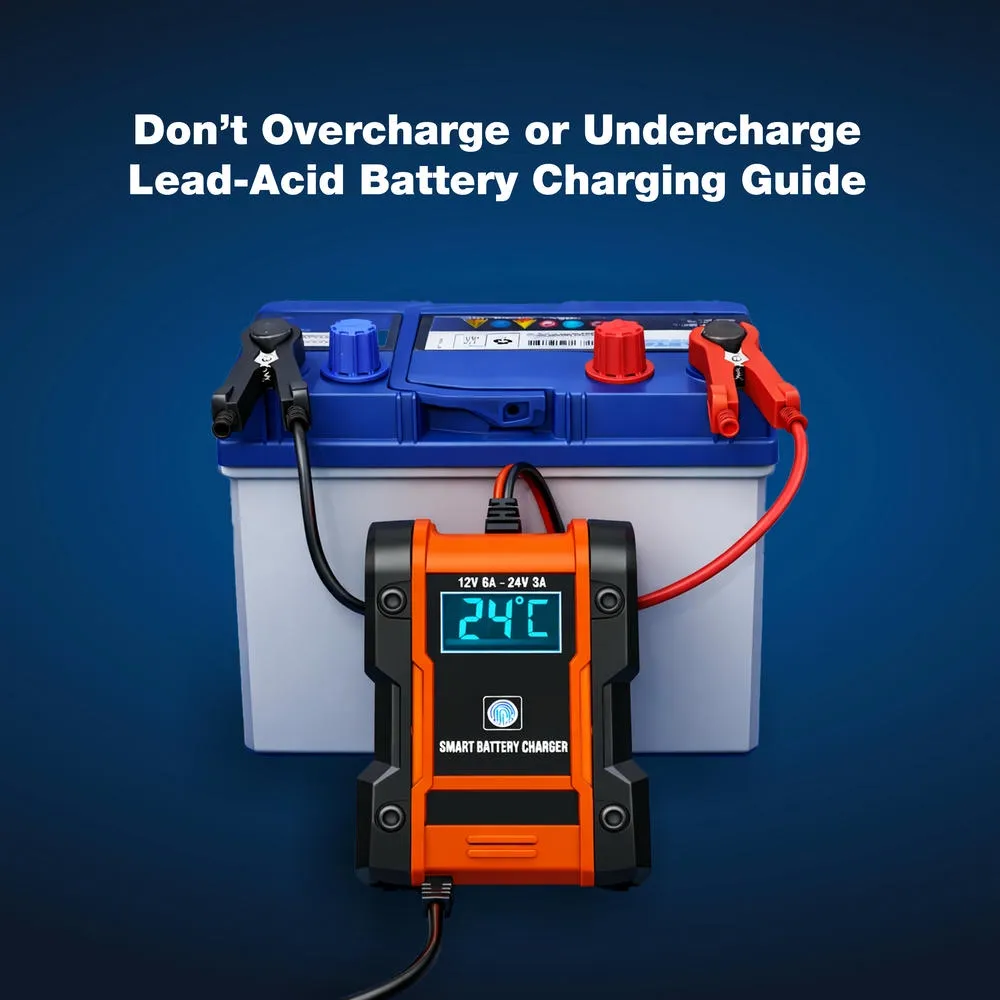
Lead-acid batteries remain the dominant rechargeable energy storage technology in vehicles, backup power systems, solar banks, and industrial equipment. Despite their durability, incorrect charging is the single biggest cause of premature failure. Both overcharging and undercharging accelerate internal degradation, reduce capacity, and shorten service life—problems that are entirely avoidable with proper charging practice.
This guide explains the science behind safe and effective charging of flooded, AGM, and gel lead-acid batteries using modern smart chargers and best-practice methods.
- Why correct charging matters
- How Lead-Acid Batteries Charge
- Multi-Stage Charging Explained
- Typical Voltages, Currents and Temperature Compensation
- Recommended Charging Parameters
- Why Temperature Compensation is Essential
- Choosing the Right Charger
- Signs of Overcharging
- Signs of Undercharging
- Equalisation Charging – When and How
- Desulphation and Recovery
- Safety Precautions
- Frequently Asked Questions (FAQ)
- Conclusion
- References
Why correct charging matters
A lead-acid cell’s electrochemistry is sensitive to both applied voltage and charge current. Lead-acid batteries depend on precise voltage and current control.
- Undercharging prevents full conversion of lead sulphate back into active material, leading to sulphation, higher internal resistance, and permanent loss of capacity.
- Overcharging forces excessive gassing, water loss, grid corrosion, and heat build-up. Flooded batteries require frequent topping-up, while sealed AGM and gel batteries can be irreversibly damaged.
Correct charging ensures the battery reaches full capacity while minimising thermal stress and gassing. Over time, proper charge control significantly extends service life.
How Lead-Acid Batteries Charge
Charging reverses the discharge reaction involving lead dioxide (PbO₂), sponge lead (Pb), and sulphuric acid (H₂SO₄). The process is not 100% efficient: typically, 10–20% of the energy of flooded batteries is lost as heat and gas evolution.
- Undercharging → accumulation of hard crystalline sulphate
- Overcharging → accelerated plate corrosion and water loss
Both conditions dramatically reduce longevity.
Multi-Stage Charging Explained
Modern, recommended charging follows a multi-stage profile:
- Bulk (constant current — CC): Restores the majority of the state of charge (SOC). The charger delivers its maximum safe current until the battery reaches the absorption voltage.
- Absorption (constant voltage — CV): Voltage is held at a fixed setpoint while current tapers naturally. This completes the final 15-20% of charge.
- Float: Voltage is reduced to a maintenance level that offsets self-discharge without causing overcharge during long-term connection.
- Equalisation (Flooded Only): A periodic, controlled overvoltage to mix electrolyte, reverse stratification and reduce sulphation.
Never applied to AGM or gel batteries.
Typical Voltages, Currents and Temperature Compensation
Charging parameters vary by battery type (flooded, AGM, gel), manufacturer, chemistry, and temperature. For 12 V batteries at 25 °C:
- Bulk / Absorption: typically about 14.2–14.8 V (lower for gel)
- Float: typically about 13.2–13.8 V.
- Equalisation (flooded only): ~15.5–16.2 V— applied briefly and only if manufacturer allows.
Charging current is typically limited to 0.1C to 0.3C (10-30% of rated capacity) for many deep-cycle batteries; starter batteries tolerate higher short-term currents but are not designed for repeated deep cycles.
Temperature compensation is essential:
- Reduce voltage at higher temperatures
- Increase voltage at lower temperatures
Typical coefficient: –3 to –5 mV/°C per cell (–18 to –30 mV/°C for a 12 V battery).
Always consult the battery datasheet for exact setpoints.
Recommended Charging Parameters
| Battery Type | Bulk/Absorption Voltage (25 °C) | Float Voltage (25 °C) | Max Charge Current | Temperature Compensation |
| Flooded (Wet) | 14.4 – 14.8 V | 13.2 – 13.5 V | 10–20 % of rated Ah | –18 to -30 mV/°C per 12 V |
| AGM | 14.4 – 14.7 V | 13.5 – 13.8 V | 20–30 % of rated Ah | –18 to –30 mV/°C |
| Gel | 14.1 – 14.4 V | 13.5 – 13.8 V | 10–20 % of rated Ah | –18 to –30 mV/°C |
(Always refer to the manufacturer’s datasheet, as values vary by brand and model
Never exceed the manufacturer’s stated absorption voltage for more than a few hours, and never apply equalisation to AGM or gel batteries.
Why Temperature Compensation is Essential
Charging voltage must be adjusted for ambient temperature:
- For every 10 °C above 25 °C, reduce voltage by ~0.18–0.30 V (12 V system).
- For every 10 °C below 25 °C, increase voltage by the same amount.
Without temperature compensation:
- Hot-climate installations become chronically overcharged
- Cold-climate installations become chronically undercharged
Quality chargers include an external temperature sensor for this reason.
Choosing the Right Charger
Select a charger with:
- Multi-stage CCCV charging
- Chemistry-specific profiles (Flooded / AGM / Gel)
- Automatic float mode
- Temperature compensation
- Current limiting
- Equalisation mode (flooded only)
Relevant safety standards include:
- IEC 60335-2-29 (household battery chargers)
- BS EN IEC 62485 series (industrial battery safety)
- IEC 60095 (automotive starter batteries)
Using a compliant charger reduces the risk of electrical, thermal, or chemical hazards.
Signs of Overcharging
- Excessive gassing or bubbling (flooded batteries)
- Battery case feels hot to the touch (>45 °C)
- Water consumption increases dramatically
- Positive plates show brown corrosion
- Reduced capacity and premature failure
Signs of Undercharging
- Persistent low specific gravity even after charging (<1.220 after full charge)
- Hard crystalline sulphate visible on plates
- Noticeable voltage drop under load
- Capacity falls below 80 % of rated Ah
Equalisation Charging – When and How
Equalisation is a controlled overcharge used only for flooded deep-cycle batteries.
Typical procedure:
- Voltage: 15.5–16.2 V
- Duration: 2–4 hours or until cell-to-cell specific gravity varies by <0.010
Stop immediately if electrolyte temperature exceeds 50 °C.
Do not equalise AGM or gel batteries — it will damage the internal pressure-relief system.
Desulphation and Recovery
High-frequency pulse chargers (e.g., CTEK Recond mode, BatteryMINDer) may partially reverse mild sulphation. Severe sulphation, however, is irreversible. Prevention through correct charging is always cheaper than attempted recovery.
Safety Precautions
- Charge in a well-ventilated area (hydrogen gas risk)
- Wear eye protection and gloves
- Use a charger matched to battery chemistry (flooded, AGM, gel) and voltage
- Monitor electrolyte levels on flooded cells and top up with distilled water after charging as required
- Disconnect the negative terminal first; reconnect last
- Apply equalisation only when recommended and under controlled supervision (ventilated area)
- Don’t attempt to charge a frozen battery or one with visible case damage
- Keep sparks, cigarettes, and flames away from charging batteries
Frequently Asked Questions (FAQ)
Conclusion
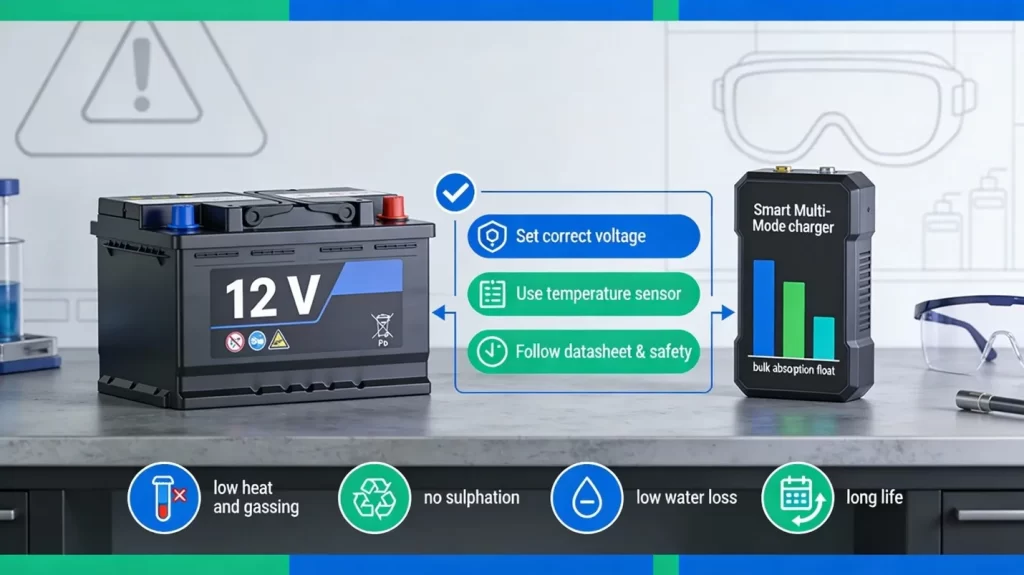
Correct charging is the single most important factor in achieving long, reliable service life from lead-acid batteries. Using a multi-stage charger with the right voltage profile, ensuring proper temperature compensation, following manufacturer datasheets, and observing safety procedures will:
- Minimise heat and gassing
- Prevent sulphation
- Reduce water loss
- Maximise runtime and cycle life
Charging discipline is the simplest and most cost-effective way to protect your battery investment.
References
- Trojan Battery Company – Master’s Guide to Battery Charging (2024) https://www.trojanbattery.com/tech-support/battery-maintenance/
- Yuasa Battery (GS Yuasa) – Technical Manual 2024 https://www.yuasa.co.uk/technical-downloads.html
- Rolls Battery Engineering – Charging Parameters (2024) https://rolls-battery.com/wp-content/uploads/2024/05/Rolls-Battery-Manual.pdf
- Victron Energy – Battery Charging White Paper (2024) https://www.victronenergy.com/upload/documents/White-paper-Battery-charging-EN.pdf
- Battery University – BU-403: Charging Lead Acid https://batteryuniversity.com/article/bu-403-charging-lead-acid
- CTEK – Charging Lead-Acid Batteries Guide (2024) https://www.ctek.com/uk/battery-knowledge/charging-guide
- International Electrotechnical Commission – IEC 62485-3: Safety requirements for traction batteries (2022)
Always consult the specific battery manufacturer’s datasheet for the final authority on charging parameters.