
Power Your Home with Car Batteries: How Many Are Enough?
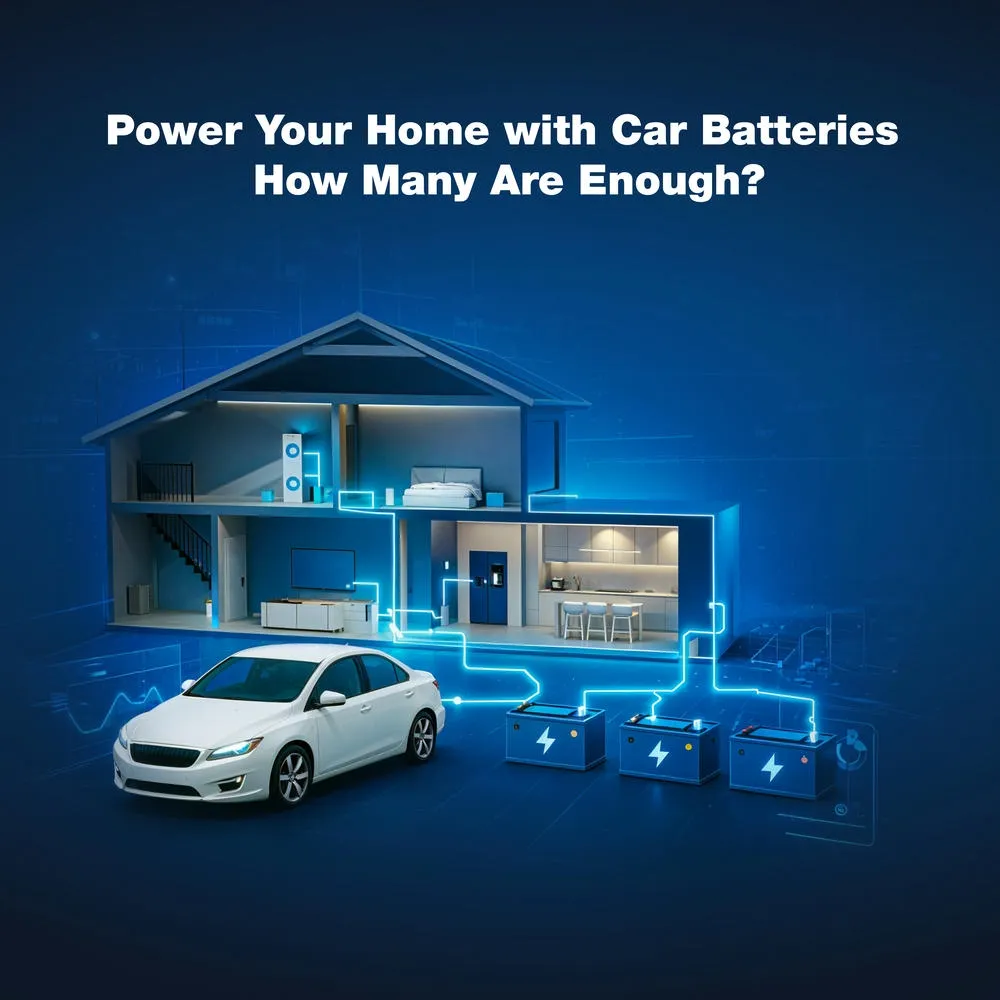
In an era of rising energy costs and increasing interest in off-grid living, many homeowners are exploring whether standard car batteries (lead-acid starter batteries) can be repurposed as a budget-friendly home energy storage solution. While deep-cycle or lithium-ion batteries are the recommended choice for whole-home or solar backup, lead-acid starter car batteries remain widely available and inexpensive.
This article examines the realistic capabilities, limitations, and safety considerations of using automotive starting, lighting, and ignition (SLI) batteries for domestic power, and answers the central question: how many would you actually need?
Can Car Batteries Realistically Power a Home?
Yes — technically — but the answer depends entirely on the battery type, usable capacity, inverter capability and the household’s energy demand. Modern EV batteries are large (typically 40–100 kWh) and, when equipped with bidirectional charging, can supply a household for many hours or days. By contrast, a single 12 V starter battery contains only a few hundred watt-hours of usable energy and is not a practical primary storage device for home use.
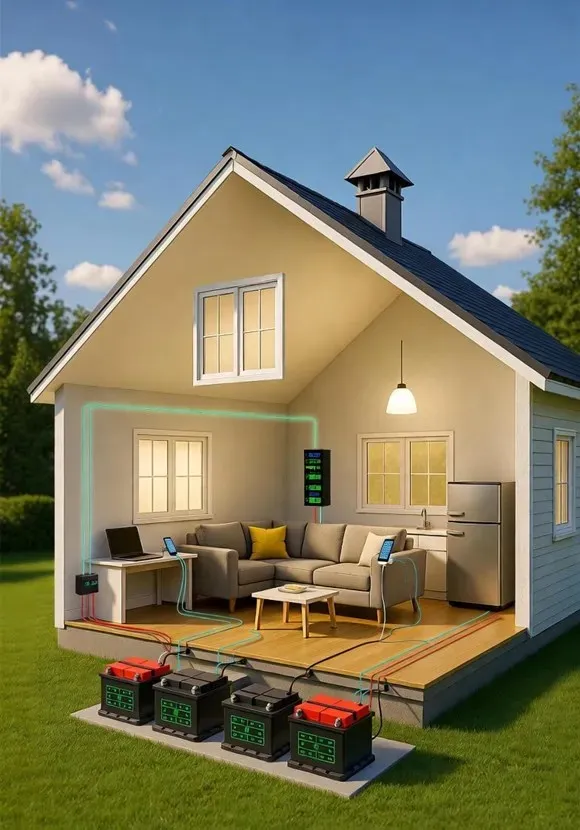
Understanding Car Batteries for Home Use
Standard car batteries are 12 V flooded or AGM lead-acid batteries designed to deliver very high current (300–800 A) for a few seconds to start an engine. Typical usable capacities range from 40–85 Ah (ampere-hours) depending on the vehicle type.
According to the Battery Council International (BCI), a typical Group 24–Group 65 passenger-car battery has a nominal 20-hour capacity of 50–75 Ah, but only ~50 % of that capacity (25–37 Ah) should ever be used if you want the battery to last more than a few dozen cycles.
Key Limitations of SLI Batteries
- Depth of Discharge (DoD): Manufacturers of SLI batteries recommend never discharging below 50 % for longevity. Regular deep discharges quickly destroy the battery.
- Cycle Life: Only 30–100 full cycles at 50 % DoD.
- Peukert’s Law: High discharge rates dramatically reduce available capacity.
- No built-in BMS (Battery Management System) – over-discharge or over-charge protection is absent.
- Ventilation requirements: Flooded lead-acid batteries release hydrogen gas.
Calculating Your Home’s Energy Needs
Key technical concepts you need to know:
- Capacity (kWh): total electrical energy a battery stores. Convert ampere-hours (Ah) to kilowatt-hours with: kWh = Ah × Volts ÷ 1,000.
- Depth of Discharge (DoD): fraction of capacity you can safely use. Typical recommended DoD for long life: 50–80% for lithium-ion (manufacturers vary); lead-acid is usually limited to ~50%.
- Round-trip efficiency (RTE): energy lost during charge/discharge and conversion (inverter + battery losses). High-quality lithium systems often achieve ~85–95% RTE at system level.
- Power (kW): maximum instantaneous supply — the inverter and battery must both support the peak load (e.g. kettles and heaters). Manufacturer datasheets specify continuous and surge power.
First convert your daily consumption from watt-hours (Wh) or kilowatt-hours (kWh) to 12 V amp-hours (Ah).
Formula: Ah required (at 12 V) = (Daily Wh consumption × 1.2 inverter loss factor) ÷ 12 V ÷ Recommended DoD (0.5)
Example: A very frugal off-grid household using LED lighting, a laptop, phone charging, and a small 12 V fridge might consume 600 Wh/day (0.6 kWh).
Ah calculation: (600 Wh × 1.2) ÷ 12 V ÷ 0.5 DoD = 120 Ah usable capacity needed
How Many Car Batteries Do You Really Need?
Assuming a typical 70 Ah (20 hr rate) car battery with only 35 Ah safely usable:
| Daily household load | Usable Ah needed | Minimum number of 70 Ah car batteries | Approx. total nominal capacity |
| 400 Wh (ultra-frugal) | ~80 Ah | 3 batteries | 210 Ah nominal |
| 600 Wh (frugal) | ~120 Ah | 4 batteries | 280 Ah nominal |
| 1,000 Wh (moderate) | ~200 Ah | 6–7 batteries | 420–490 Ah nominal |
| 2,000 Wh (average UK home essentials only) | ~400 Ah | 12–14 batteries | 840–980 Ah nominal |
Practical Examples and Worked Calculations
Scenario A – Weekend cabin (400 Wh/day) Lights (50 W × 5 h) + phone charging (50 Wh) + small 12 V fridge (300 Wh) = 400 Wh Ah needed = (400 × 1.2) ÷ 12 ÷ 0.5 = 80 Ah → Three 70 Ah batteries in parallel (210 Ah nominal, 105 Ah usable) give ~30–40 % safety margin.
Scenario B – Emergency blackout backup for essentials (1 kWh/day) Fridge-freezer (600 Wh) + LED lighting (100 Wh) + Wi-Fi/router + phone charging (300 Wh) = 1,000 Wh Ah needed = (1,000 × 1.2) ÷ 12 ÷ 0.5 = 200 Ah → Minimum six 70 Ah batteries (420 Ah nominal → 210 Ah usable).
Safety and Legal Considerations
- Installation of high-voltage packs and repurposed EV modules requires compliance with electrical safety and energy storage standards (for example IEC 62933 series) and professional installation.
- Hydrogen venting: The UK HSE and IET Wiring Regulations (BS 7671) require batteries to be installed in well-ventilated or outdoor locations.
- Fusing and isolation: Each parallel string must have its own fuse; total current can exceed 1,000 A on short-circuit.
- Insurance: Many home-insurance policies exclude damage caused by non-compliant DIY battery banks.
- Local electrical codes vary by country (NEC in the USA, IEC/EN in Europe, etc.). Always consult local regulations.
Better Alternatives in 2025
While lead-acid car batteries can work for very small loads or short-term emergency use, purpose-built solutions are dramatically superior:
- AGM deep-cycle leisure batteries (200–300 cycles at 50 % DoD)
- Lithium LiFePO4 batteries (2,000–7,000 cycles, 90–100 % DoD, built-in BMS)
- Second-life EV batteries
Frequently Asked Questions
-
-
Yes, but it’s not recommended. Starter batteries are designed for short, high-current bursts and have low usable capacity and poor cycle life for deep discharge. Use deep-cycle batteries or purpose-built systems. provided they are the same type, age, and capacity, but lifespan will be severely limited.
-
-
A modern A+++ fridge-freezer averages 1–1.5 kWh/day. Four 70 Ah batteries give ~140 Ah usable → ~1,400 Wh at 12 V after losses → roughly 24–30 hours maximum.
-
-
Rarely. Most are already sulphated and deliver <30 % of rated capacity.
-
-
Initially yes (£50–£80 per battery vs £500+ for a 1 kWh LiFePO4 unit), but replacement every 6–18 months reverses the savings.
-
-
For modern Li-ion systems plan on 85–95% RTE; for lead-acid expect closer to 70–80% overall. Account for inverter and ancillary losses.
Conclusion
Car batteries can power homes — but “how many” depends on the battery type, usable capacity (DoD), inverter and round-trip losses, and your household consumption. Generally, car batteries can provide very limited emergency or ultra-low-budget power for loads under 500–600 Wh per day, typically requiring 3–6 batteries. For anything beyond occasional weekend or blackout use, the poor cycle life, safety requirements, and rapid degradation make them a false economy. In 2025, falling lithium LiFePO4 prices (now often below £200/kWh) and the availability of second-life EV packs mean purpose-designed home storage is safer, longer-lasting, and ultimately cheaper.
If you choose to experiment with car batteries, treat them as a short-term learning step rather than a long-term solution—and always prioritise ventilation, fusing, and never discharge below 50 %.
References
- Battery Council International – SLI Battery Specifications https://batterycouncil.org
- UK Health & Safety Executive – Guidance on Battery Storage Ventilation https://www.hse.gov.uk
- IET Wiring Regulations BS 7671:2018+A2:2022 – Section 740 (Temporary electrical installations & battery storage)