
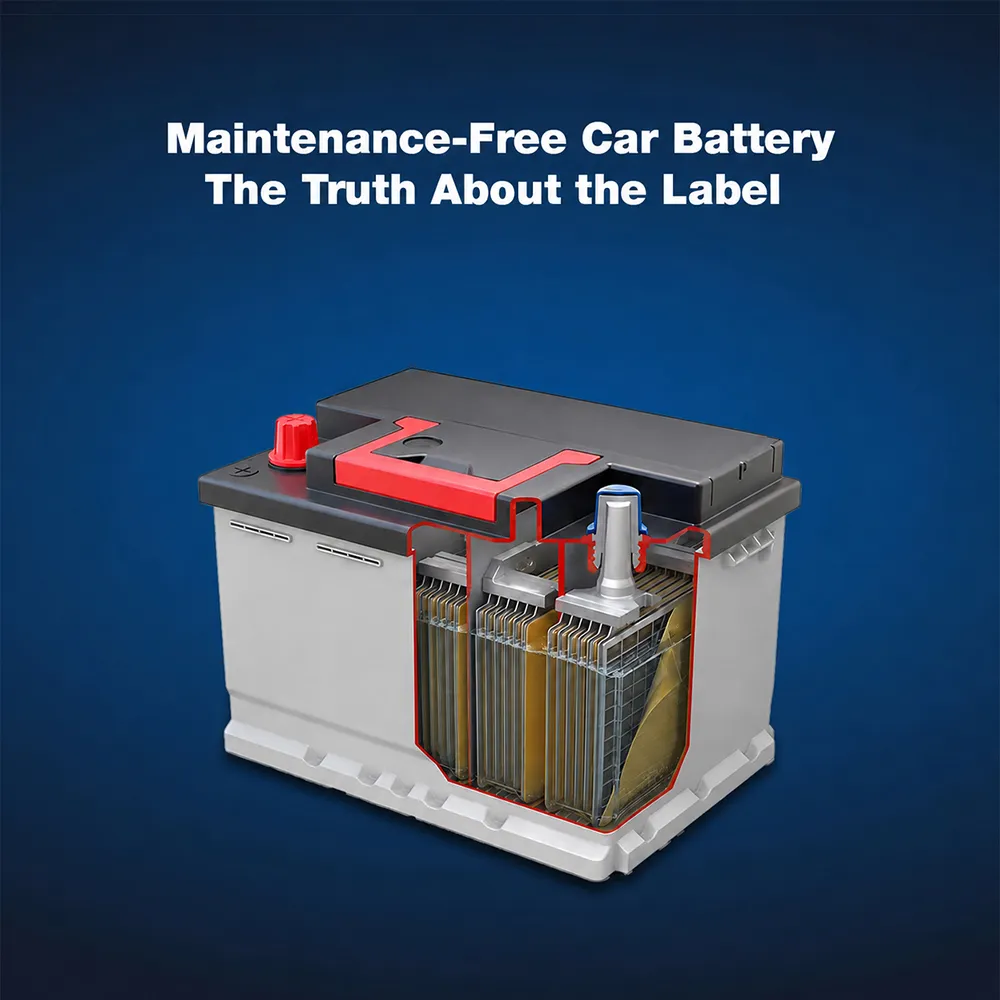
- Maintenance-Free Car Battery: What the Label Really Means
- Maintenance-Free Car Battery: Definition
- Where the Term “Maintenance-Free” Came From
- What a Maintenance-Free Car Battery Really Means
- How Modern Maintenance-Free Batteries Are Designed
- Types of Maintenance-Free Car Batteries
- Why Manufacturers Use the Term
- Factors That Still Affect Maintenance-Free Batteries
- Maintenance-Free Car Battery Myths
- When Maintenance-Free Batteries Still Need Attention
- How Modern Vehicles Increased Battery Stress
- Practical Implications for Car Owners
- Key Takeaways
- FAQs
- Final Thought
Maintenance-Free Car Battery: What the Label Really Means
The phrase maintenance-free car battery sounds reassuring.
No topping up. No checks. No worries.
But what does maintenance-free actually mean?
In engineering terms, the reality is more nuanced—and far more interesting—than the label suggests.
Modern car batteries are undeniably more reliable and user-friendly than older designs. However, maintenance-free is not a permanent state. It is a design approach shaped by electrochemistry, metallurgy, vehicle electronics, and modern driving patterns.
Understanding the true meaning of a maintenance-free car battery helps drivers avoid premature failure, choose the correct replacement technology, and set realistic expectations.
Maintenance-Free Car Battery: Definition
Maintenance-free car battery
A lead-acid battery designed to operate for most of its service life without routine electrolyte topping-up, achieved through reduced water loss and sealed or semi-sealed construction.
Key clarification:
Maintenance-free does not mean immune to misuse, overcharging, or ageing.
Where the Term “Maintenance-Free” Came From
In earlier vehicles, battery maintenance was a routine task. Traditional flooded lead-acid batteries consumed water during normal charging. Owners were expected to:
- Remove vent caps
- Check electrolyte levels
- Add distilled water regularly
The introduction of calcium-alloy lead grids in the late twentieth century dramatically reduced water loss. Electrolyte levels stabilised, and routine refilling became unnecessary under normal conditions.
The term maintenance-free emerged to describe this improvement—not to imply zero care, but the absence of regular water topping-up.
What a Maintenance-Free Car Battery Really Means
What it does mean
- No scheduled electrolyte refilling
- Reduced gassing during normal charging
- Sealed or controlled-vent casing
- Designed for standard automotive charging systems
What it does not mean
- Protection against overcharging
- Immunity to heat or deep discharge
- Freedom from ageing or degradation
- Universal suitability for all vehicles
Most confusion around maintenance-free batteries stems from ignoring this distinction.
How Modern Maintenance-Free Batteries Are Designed
Calcium-Alloy Grid Technology
Calcium replaces antimony in the lead grid, reducing water electrolysis. This leads to:
- Lower water loss
- Reduced visible gassing
- Longer service intervals
Sealed and Labyrinth Vent Systems
Instead of removable caps, modern batteries use:
- Pressure-regulated vents
- Labyrinth pathways that condense and return vapor
Electrolyte loss is reduced—but not eliminated under thermal or electrical stress.
Internal Gas Recombination
In sealed designs, limited recombination of oxygen and hydrogen forms water internally. This improves efficiency only within strict operating limits.
Types of Maintenance-Free Car Batteries
| Battery type | Maintenance characteristics | Typical application |
| Flooded calcium | Low routine maintenance | Conventional vehicles |
| AGM battery | Fully sealed, charge-sensitive | Start-stop, premium cars |
| EFB battery | Reduced water loss, semi-sealed | Mild start-stop systems |
AGM and EFB batteries are often marketed as maintenance-free, but they require more precise charging control, not less.
Why Manufacturers Use the Term
From an engineering perspective, maintenance-free indicates:
- Reduced owner intervention
- Compatibility with modern electrical systems
- Predictable performance over service life
As manufacturers such as Suzuki note in technical documentation, the objective is reliability—not neglect tolerance.
The term survived because it solved a real problem: drivers no longer needed to think about electrolyte levels. Unfortunately, the wording sometimes encourages drivers to stop thinking about batteries altogether.
Factors That Still Affect Maintenance-Free Batteries
Temperature
- High heat accelerates grid corrosion and water loss
- Extreme cold increases cranking demand and internal resistance
Driving Patterns
- Short trips prevent full recharge
- Long idle periods encourage sulphation
Charging Systems
- Variable-voltage alternators alter charging profiles
- Smart charging may undercharge batteries during certain cycles
A sealed casing does not eliminate these effects.
Maintenance-Free Car Battery Myths
Myth: Maintenance-free batteries do not fail suddenly
Fact: Reduced warning signs often make failure appear abrupt
Myth: Maintenance-free batteries cannot be damaged
Fact: Overcharging is especially harmful in sealed designs
Myth: All maintenance-free batteries are the same
Fact: AGM, EFB, and flooded batteries behave very differently
When Maintenance-Free Batteries Still Need Attention
Even without water refilling, responsible ownership still involves:
- Periodic voltage checks
- Correct replacement battery specification
- Monitoring charging system behaviour
- Avoiding deep discharges
Neglect rarely causes instant failure—but it shortens lifespan quietly.
How Modern Vehicles Increased Battery Stress
Modern vehicles place continuous demand on their batteries through:
- Start-stop systems
- Multiple Electronic control units (ECUs)
- Constant standby loads
- Regenerative and variable charging
Despite being labelled maintenance-free, today’s batteries often operate under greater stress than older designs.
Practical Implications for Car Owners
- Expect reduced routine maintenance, not zero responsibility
- Match battery technology to vehicle requirements
- Recognise that sealed designs trade accessibility for precision
Maintenance-free batteries perform best when treated as engineered systems—not disposable components.
Key Takeaways
- Maintenance-free means no water topping-up, not no care
- Modern batteries reduce visible maintenance but are more sensitive to misuse
- AGM and EFB batteries demand accurate charging
- Environment and usage still determine battery lifespan
- Understanding the label prevents costly mistakes
FAQs
Final Thought
The truth about maintenance-free car batteries is not disappointing—it is empowering.
Once drivers understand what the label really signifies, these batteries become exactly what they were designed to be: quietly dependable, not magically indestructible.